Cheap sound insulation

la toilette

Downright stupid
Joined
Jan 21, 2005
Messages
1,213
Reaction score
0
Location
Somerset
Hi All,

I removed the lath and plaster ceiling in my dining room over the weekend as it was a bit knackered after we removed a minor internal partition. We now have lovely exposed old timbers but I need to insert plasterboard between the floor joists as the room above has exposed floorboards, to re-introduce a bit of privacy between the floors! I figured that while I'm at it I may as well put an extra layer of something above the plasterboard to increase the sound insulation......but having done a quick search on the web the specialist acoustic membranes are really bloody expensive, and I'm not doing this to soundproof the room for any particular hifi useage etc.

Anyone come across anything cheap and relatively effective for this purpose that I could try? I don't want anything thick really, maybe and inch thick max ideally, and not too heavy. And not a fire hazard.

I found a crispy old rat corpse curled up under the boards, fortunately very old and very dead! These old cottages! :D
 
removing the ceiling has reduced the fire resistance of the floor.

apart from risk to occupants you may find your insurance is null & void if you ever have a fire.

There are many products and methods available which will allow you to meet building regulation requirements. Ask your local building control for advice & it may be worth treating the exposed joists with nullifire or similar.

It depends which country you live.
 
removing the ceiling has reduced the fire resistance of the floor.

apart from risk to occupants you may find your insurance is null & void if you ever have a fire.

There are many products and methods available which will allow you to meet building regulation requirements. Ask your local building control for advice & it may be worth treating the exposed joists with nullifire or similar.

It depends which country you live.

Thanks for your concern, but I'm not overly bothered at having exposed joists. My house is over 300 years and despite having an enormous amount of exposed timber it has managed to survive thus far without bursting into flames. All the internal partitions and panelling are original timber ones. In fact the ceiling I have taken down is a later Victorian one, and there's plenty of evidence to suggest that it didn't originally have a secondary covering at all, that room having been a store room and there being various nails and pegs in the joists for hanging stuff from.

I appreciate the logic behind most modern building regs, but they're more appropriate for modern buildings than older properties like mine, and there's no way I'm going to start squirting chemicals all over the place in the hope that it may reduce the fire risk. I have an old house and am not going to try and turn it into a new one. That said I'm following the appropriate regs whenever it's sensible to do so or if I'm obliged to do so, just not dogmatically :).
 
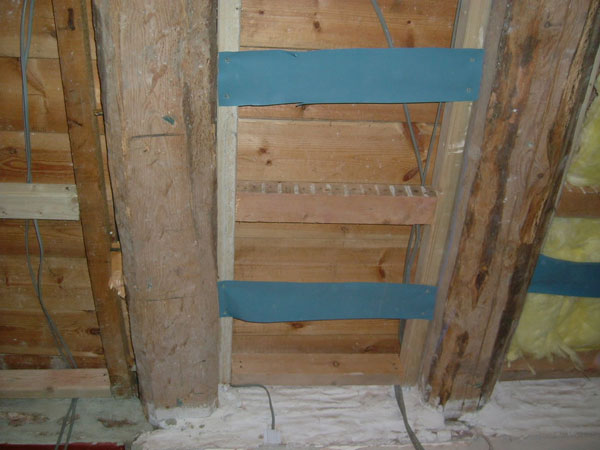
We (ok builders) did exactly what you are talking about a few years back. As it was part of a project it needed building regs approval anyway. There was no particular additional provision for fire as I remember; fibre glass for sound and heat insulation then plasterboard. They did have a neat way to hold the insulation in place as they worked though - might have a pic somewhere.

ceiling_insulation.jpg


edit: pic added, insulation just going in on right, poly strips hold it in place.
 
Last edited by a moderator:
LT - There's no need to pay for the 'acoustic' label on insulation - you can use regular mineral fibre insulation, just go for the highest density you can secure. Knauf and the like all do general-purpose rolls which are ideal (e.g as sold through Wickes or Sheffield Insl) You can also buy semi-rigid board, which at >30Kg/m^3 is ideal but much more expensive and it would make very little difference in this particular context. By placing pieces of ceiling (plasterboard) up between the joists you've inherently compromised isolation between the rooms, but given the basic construction here I very much doubt you'll notice the difference.

The fire issue is a slight aside, and very easily resolved - in fact what you are proposing can address this sufficiently and directly. I can forward the relevant BRE technical note if you PM me an email address.
 
19mm Thick Gyproc Plank is useful in this instance if you want maximum mass in a single layer without too much expense.
http://www.british-gypsum.com/products/plasterboard___accessories/gyproc_acoustic/gyproc_plank.aspx

It comes in 600mm wide sections (rather than 1200mm) so isn't too heavy to handle. It's really the cheapest form of getting maximum mass for your money (used in cinema walls, etc.). Failing that, just do a double layer of standard 12.5mm Gyproc Wallboard.

For mineral wool, the various densities are given here (use 100mm thick and no point going OTT with the density in your case):

http://guide.rockwool.co.uk/media/75935/rigid sr fs-sec.pdf
 
Cheers for the replies guys, all very helpful. I must say I'm tempted by the more rigid material as it would probably be easier and less unpleasant to install. Thick mineral wool is no good for me as I don't want that depth, but if it's a cheaper option I may go for a thinner version.

Thanks for the offer Felix, pm sent!
 
Back
Top