
I was wondering how you would go about bi amping with a 306 when there is only stereo input and no output loop? Would simply soldering the two phono inputs together in each amp and using one for left and one for right work?

You are using an out of date browser. It may not display this or other websites correctly.
You should upgrade or use an alternative browser.
You should upgrade or use an alternative browser.
bi amping with a quad 306
- Thread starter rsand
- Start date


Splitter cable is what you need.
One RCA plug at the source (pre) end running to a pair of RCAs wired in parallel for the power amplifiers.
Nice amplifier, and very underrated.
Rob do you know if that splitter cable is commercially available?
I have just bought a 306 myself, Grey casework in very nice condition with few if any scratches / marks, and it really sounds very nice indeed for an outlay of £130.
Quick peek inside shows that its all original and dates from 89 some of the caps look a bit iffy so no doubt its going to need a service soon, any advise on where to obtain the bits and what to buy would be appreciated
Andy
Andy, I'll dig out the part numbers tomorrow and post them up.
I haven't seen the cables for sale, but if you want something made up let me know.
Cheers Rob I will look out for the parts Numbers, and will come back to you if / when I find another 306
Andy

RobHolt
Moderator
- Joined
- Oct 23, 2004
- Messages
- 4,126
- Reaction score
- 12
Andy, fortunately there are very few electrolytic caps in a 306. Just one 47uf and four 4700uf. Use 6800uf for the latter when servicing.
I use RS Components and these are the links:
C7 - X1 - http://uk.rs-online.com/web/p/products/628-3863/
C10/11 - X4 - http://uk.rs-online.com/web/p/products/339-7060/
You can download the Quad 306 Service Manual from our reference section here - http://www.audiosmile.com/forum/Manual/Quad 306 Service.pdf
I use RS Components and these are the links:
C7 - X1 - http://uk.rs-online.com/web/p/products/628-3863/
C10/11 - X4 - http://uk.rs-online.com/web/p/products/339-7060/
You can download the Quad 306 Service Manual from our reference section here - http://www.audiosmile.com/forum/Manual/Quad 306 Service.pdf
Thanks Rob and parts ordered.
Andy
Andy
Rob
RS have informed me the C10/C11 location caps are currently out of stock.
I have had a look around for similar spec caps and have found plenty of 6800uf 63v available, however, and the main point of the post for a novice like me is does the operating temperature matter? I notice that the ones you linked to have a 105 degree max temp whereas lots I have seen only go up to 85 degree.
I vaguely remember reading in some Quad publication about the original caps being painted with a temperature sensitive paint that changed colour if the cap had been subject to an overheated environment (115 degrees rings a bell).....and therefore I guess I have just answered my own question and I need to look out for 105 degree caps
RS have informed me the C10/C11 location caps are currently out of stock.
I have had a look around for similar spec caps and have found plenty of 6800uf 63v available, however, and the main point of the post for a novice like me is does the operating temperature matter? I notice that the ones you linked to have a 105 degree max temp whereas lots I have seen only go up to 85 degree.
I vaguely remember reading in some Quad publication about the original caps being painted with a temperature sensitive paint that changed colour if the cap had been subject to an overheated environment (115 degrees rings a bell).....and therefore I guess I have just answered my own question
and I need to look out for 105 degree caps
The 85degree ones will do just fine if that's what you can get.
Reservoir caps run warm inside due to the high ripple currents they endure, and consequent I^2 *ESR losses (Joule heating). Electrolytic cap life essentially halves for every 10degreeC rise in internal temp, pretty much after Arrhenius' Equation. BTW, manufacturers usually rate lifetime of electrolytic caps as the point at which ESR doubles - partly because this massively increases losses and so the performance slides off the page soon after.
Anyway, say a given electrolytic cap is rated for just 3000hrs life at 85degC. Do check the datasheet for this info- it's normal-to-good performance BTW although it looks horrific since 3000hrs ~ only 5months.
Let's look at that: say the cap runs at 45degC - about as hot as you can comfortably touch for >10secs - when inside a piece of running equipment. Then its rated performance should last about 2^[85-45) / 10] or 2^4 = 16 x the rated life. That's 16x3000hrs or say 6 years. You might similarly calculate a 105degC, 3000-hr rated part to last over 20yrs; but the truth is the terminal seals will likely fail first, and a preventative change at c.12-15yrs will still be worthwhile.
Either way still gives an expectation of life > 6 -10yrs continuously powered.
(Also you'll see why a handful of conscientious manufacturers bother to recommend service between 7-10yrs. It's based on good physics, not revenue)
Reservoir caps run warm inside due to the high ripple currents they endure, and consequent I^2 *ESR losses (Joule heating). Electrolytic cap life essentially halves for every 10degreeC rise in internal temp, pretty much after Arrhenius' Equation. BTW, manufacturers usually rate lifetime of electrolytic caps as the point at which ESR doubles - partly because this massively increases losses and so the performance slides off the page soon after.
Anyway, say a given electrolytic cap is rated for just 3000hrs life at 85degC. Do check the datasheet for this info- it's normal-to-good performance BTW although it looks horrific since 3000hrs ~ only 5months.
Let's look at that: say the cap runs at 45degC - about as hot as you can comfortably touch for >10secs - when inside a piece of running equipment. Then its rated performance should last about 2^[85-45) / 10] or 2^4 = 16 x the rated life. That's 16x3000hrs or say 6 years. You might similarly calculate a 105degC, 3000-hr rated part to last over 20yrs; but the truth is the terminal seals will likely fail first, and a preventative change at c.12-15yrs will still be worthwhile.
Either way still gives an expectation of life > 6 -10yrs continuously powered.
(Also you'll see why a handful of conscientious manufacturers bother to recommend service between 7-10yrs. It's based on good physics, not revenue)
Last edited by a moderator:
RobHolt
Moderator
- Joined
- Oct 23, 2004
- Messages
- 4,126
- Reaction score
- 12
Agree with all of the above.
However I'd be tempted to hang on for the Panasonic caps from RS.
They combine low ESR, 105 deg ratinng, good value and importantly, small size. The latter is important so if going for an alternative do check the size since some 6800uf 63v caps won't fit inside the 306.
I've serviced a few of these now, plus a goodly number of 405s and rate Panasonic caps highly.
Very good performance at reasonable cost.
Just on the point of temperature sensitive paint, this was applied to the output transistors. The pink dots turn purple if the devices get too hot, which indicates that the heat sink bond has been compromised.
However I'd be tempted to hang on for the Panasonic caps from RS.
They combine low ESR, 105 deg ratinng, good value and importantly, small size. The latter is important so if going for an alternative do check the size since some 6800uf 63v caps won't fit inside the 306.
I've serviced a few of these now, plus a goodly number of 405s and rate Panasonic caps highly.
Very good performance at reasonable cost.
Just on the point of temperature sensitive paint, this was applied to the output transistors. The pink dots turn purple if the devices get too hot, which indicates that the heat sink bond has been compromised.
Thanks Lads excellent response from both of you.
I will hang on for the Panny Caps from RS. which will give me chance to practice my soldering
I will hang on for the Panny Caps from RS. which will give me chance to practice my soldering

- Joined
- Sep 17, 2011
- Messages
- 1
- Reaction score
- 0
The Kendiel caps fit and sound very nice into the 306 available from Avondale Audio 105 degC as wel
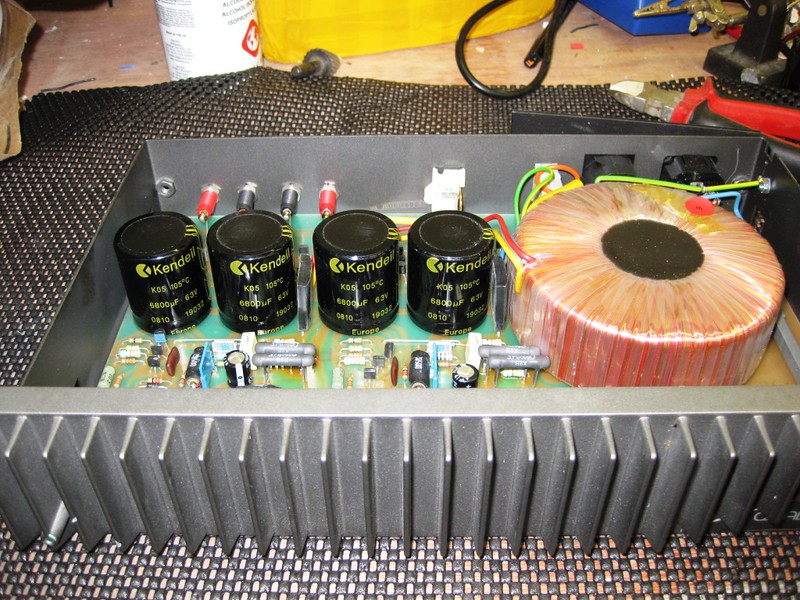 quad 306 kendeil by 337alant, on Flickr
Alan
quad 306 kendeil by 337alant, on FlickrAlan