Different platter mat material

rsand

I can't feel my toes
Joined
Feb 24, 2005
Messages
903
Reaction score
0
Location
Liverpool
I was wondering what effect the different platter mat materials have on the sound?

My glass plattered Rega comes with felt as standard but its clearly been washed and needs replacing. Should I just replace it like for like (about £10) or change it for something else?

I've seen cork like some of the projects use for £10, various vinyl ones on ebay from £20+ and the then there's branded versions like the achromat at £70 which seems a lot?
 
Platter mats

Coincidently I have just been looking into this myself. The mat that I had used for many years had started to go very brittle and break up. I think I bought it from Tandys.It was made of an anti static foam similar,but with a more open cell structure,to the stuff you plug integrated circuits into to protect against static charge.
After looking on the internet but cringing against the prices I decided to make one.
Cork seemed to have a number of followers so I decided on that as the material.I found a supplier of cork floor tiles and was able to buy a sample tile for a fraction over £1 including postage.The tile was 6mm thick and just plain cork with no sticky backing.
I drew a line around an old LP and cut it out with a junior hacksaw finishing off with glass paper on a sanding block.Having drilled the hole in the centre,marked out earlier with the LP,I fitted it to the deck and placed an LP on it. That was when I discovered my first mistake.It is very difficult to lift an LP off a mat that was the same size as the record.I removed the mat and remarked it out using the original Thorens mat as a template.
A bit more sanding and it was finished.
Obviously due to the thickness of the cork you can only do this if you can easily adjust the height of the arm,on my SME it's a two minute job.
Result,far better than I had ever really thought possible,hence my reluctance to spend any real money on it. So in answer to your question,yes ,the mat can make a difference.I am extremely happy with my result and to my ears it is superior to the original Thorens mat.
 
I've experimented extensively with mats and have either made or bought (or both) most of what exists, including, glass, acrylic, CF, graphite, cork, felt, paper, foam etc.

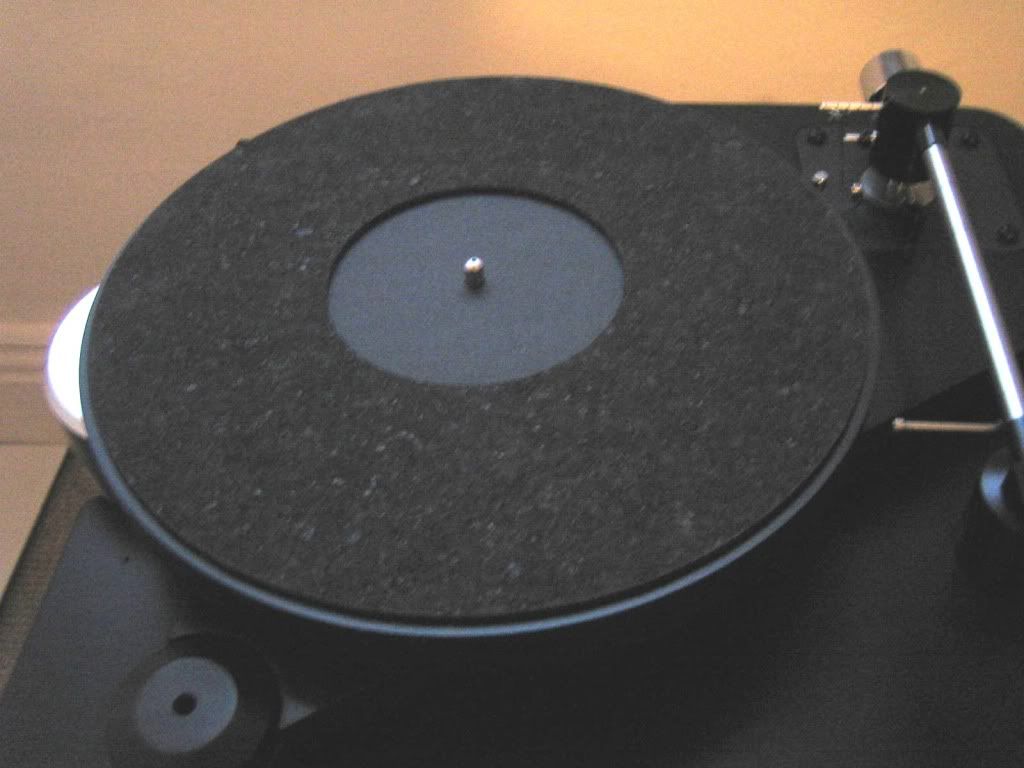
Here is a cork one I made:

1-3.jpg


It is also made from a cork tile (but only 3mm thick) - it was just cut out with a really sharp craft knife and dyed with black ink (like for a fountain pen). It has a bit of black card stuck to the back to make the label recess and locate the spindle. If you want cork with rubber bits in it you can buy cork gasket material from eBay.

Mats definitely make a difference and that difference can be quite profound. However, your system does have to be pretty transparent to show those differences (a mixed blessing)

Most mats just act as a type of tone control by attenuating (damping) some frequencies more than others.
 
Thanks for the info.

Pete, I have the exact same foam mat! Its left over from my previous encounter with vinyl and its the reason I asked this question. Initially I ditched the felt mat that came with the TT because of its poor state but swapped back out of curiosity and realised the felt sounded far better.

I like the sound I'm getting so happy to buy another one but thought I would seek advice on my options especially if theres even more to be had using something else. Being newly returned to vinyl I don't have anything to compare it to.

VTA isn't easily adjusted and my platter is glass.
 
Felt is actually a good compromise (though not exotic).
_____________________

P.S. You need to put
tags either end of your sig if you want it to show like this:

Sigstrip-ZG.jpg
 
Thanks YNMOAN actually I should just delete that as I've not been offering design or illustration for about 5 years :)
 
YNMOAN from my experience ink tends to leave a residue for example if you were to rub your hand against it, was this an issue? The black sure looks neater than natural cork.

I've ordered some 0.8mm thick so I can layer it up to make the mat 1.6 or 2.4 thick which will give me some VTR control on the p25. It also means the top layer can have a label cutout.

I thought it worth a try for for £2 if I prefer felt then its not a big deal
 
Felt is actually a good compromise (though not exotic).

I was rather pleased with the results from a thickish (5mm or so) pure wool felt mat - but was then pretty sure I had issues with static (something that's never usually a problem as it's so damp here) so stopped using it.
 
So how about platter material itself? I thought maybe the best solution would be a skeleton frame since it won't resonate, but Rob said the mat and platter need to damp vibrations from the record. If that's the case might it not be best to use the exact same material records are made from, so there is no impedance mismatch between them and the energy will transfer effectively from the record to the platter and can then be damped?
 
Many turntable platters are vinyl I think the Michell decks are but they usually use a clamp too is this because of record slip or clatter on records with any kind of warp/distortion?

You can buy aftermarket acrylic platters for the Rega's but they are pricy and still not vinyl, is acrylic really much better than glass?
 
Last edited by a moderator:
No, the black ink does not leave a surface residue, it is absorbed into the surface of the cork (use a permanent ink as for fountain pens).

I have found that thin felt mats sound better than thick ones, but static always seems a bit of a problem with felt mats.

It is a nice idea that the platter should absorb resonance within the vinyl. However, I would counter that vinyl is not a resonant material and does not require damping in this manner; indeed, it is remarkably well damped material in itself. Adding parasitic mass, or additional damping, only serves to attenuate some frequencies at the expense of others, causing colouration.

There is always an impedance mis-match because the record is never truly one with the platter, the record is grooved after all. In addition, even clamped records are not clamped in an even manner to the surface of the platter.

(perhaps I should mention that I do not actually use the cork mat in my picture; it is only on my deck for the purpose of photographing it)
 
Last edited by a moderator:
So how about a platter mat made from that soft sticky plastic, you know the stuff they made rollers from that pick up dirt but can wipe clean under water. t would mould to the shape of the record sitting on it so should provide extreme damping.
 
Well, A/ it would have to be attached to a sub layer because it lacks the rigid structure required to hold itself unsupported - so would basically be a mat, B/ see my comments regarding uneven/unequal attenuation and C/ my experience of heavy damping is that is sounds awful, robbing the music of air and dynamic - Sorbothane mats sound dire (for example).

Basically, my experience is that the more damping you add to a record the worse the sound is, or the more extreme the added colourations are. The best supports provide minimal extra damping (the record is sufficiently well damped already).
 
Last edited by a moderator:
don't think anyone has mentioned leather yet - it's what I've been meaning to try next and there's a fair bit of chatter about it's benefits around the hi-fi web.
 
So how about a platter mat made from that soft sticky plastic, you know the stuff they made rollers from that pick up dirt but can wipe clean under water. t would mould to the shape of the record sitting on it so should provide extreme damping.

Those have existed is some form.

Mark might certainly remember the old Dumpa and Spectra mats which were soft and felt sticky to the touch. You had to practically peel the dis from them.

IMO they sounded dreadful though. Flat dead and lifeless.

On the point of a skeletal platter and record damping, the concern is always how the record is supported, because the point where it is being supported will behave differently in terms of damping and energy transmission to those areas where is isn't. Performance will be inconsistent across the disc.
Noe I guess you could attempt supporting it at the centre and periphery, which might work better, but then you cannot damp the vinyl, should you wish to.
 
Those have existed is some form.

Mark might certainly remember the old Dumpa and Spectra mats which were soft and felt sticky to the touch. You had to practically peel the dis from them.

IMO they sounded dreadful though. Flat dead and lifeless.

Yes, indeed; I remember both the products you mention and entirely agree with your synopsis of their qualities.

On the point of a skeletal platter and record damping, the concern is always how the record is supported, because the point where it is being supported will behave differently in terms of damping and energy transmission to those areas where is isn't. Performance will be inconsistent across the disc.
Noe I guess you could attempt supporting it at the centre and periphery, which might work better, but then you cannot damp the vinyl, should you wish to.

For very much the reasons you give, I choose to support at the centre (I don't think supporting at both the centre and the outer edge works). As you say, this provided minimal (if any) extra damping, but I have found this to be an active benefit, rather than a limitation, and give the least colouration.
 
That's because it's a picture of a cork TT mat - not what I actually use.
 
You mean the mat supports at the centre? I thought you meant the whole platter. I think that's what Rob was talking about; the entire platter just supporting at the centre and outer edge.
 
Back
Top