

I've been building a speaker for my sister-in-law recently as a present and used some drivers I had spare. The tweeter is the Seas
magnesium dome with DXT waveguide. On paper these look superb - the distortion is really very low. They basically take the motor of a very good tweeter (the 27TBFC) and use a stiffer dome and add a waveguide. The waveguide is special because it is the first to implement controlled diffraction to widen the top end dispersion. It works well, the waveguide narrows the low end (~3KHz) dispersion to better match mid-woofers and the diffraction rings widen the top end to give an even more airy and wider sweet-spot than a regular dome.
To make a comparison here is the frequency response on and off-axis of the standard dome 27TBFC

Here is the same measurments for the DXT - You need to ignore the rise in the middle of the range which would be made flat by the crossover. Just look at the relative levels of the off-axis responses. The top end doesn't roll away so fast off-axis and the bottom end narrows off-axis more like a woofer would.

I must say though I am not too impressed with the sound. How can that be!? It has really low distortion and good dispersion characteristics! It sounds a little rough and not focused. Certainly not bad, but not as good as the planar in the Kensai or Rob's ESLs.
I know what you're thinking, it must be the decay plot, right? The waveguide must be adding some horrible ringing. Nope! (Well not <25KHz)
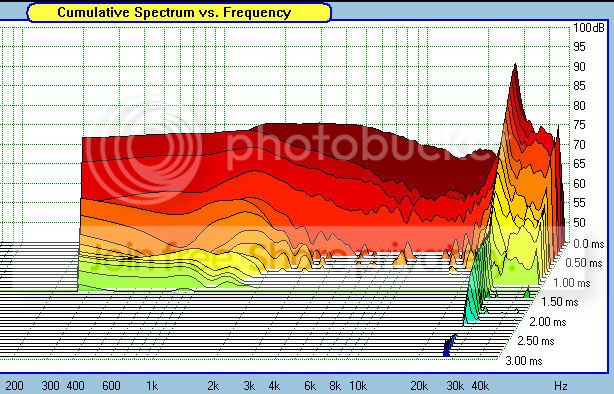
Well, as always there is a good reason for subjective sound quality. It's just a case of needing to look a little closer. In a way it is the decay where this tweeter is odd, but it is over a very short time period. Lets have a look at the Impulse response.
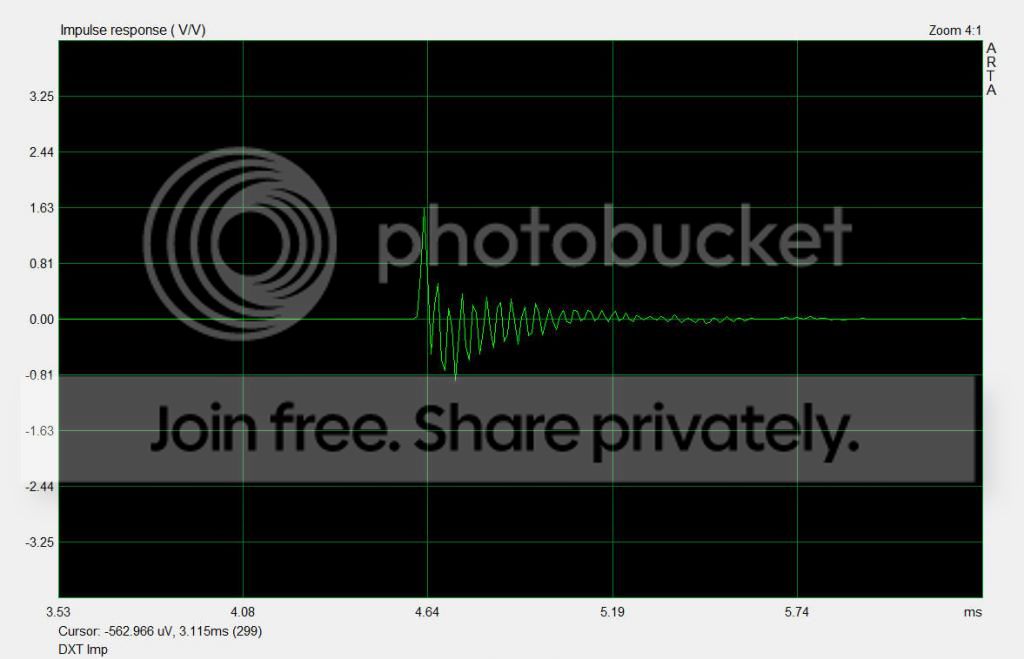
Ahh now that is unusual! All those little spikes are the reflections from the diffraction rings. This is an aspect of the DXT waveguide I have never seen mentioned before so I thought I'd share it here. The subjective difference in sound between this tweeter and the Kensai one is indeed similar as when you add a sheet of felt around the baffle of a speaker and everything becomes more focused, intimate and calm.
By way of comparison here is the impulse response for the direct radiator tweeter in the AS3/6 speaker.
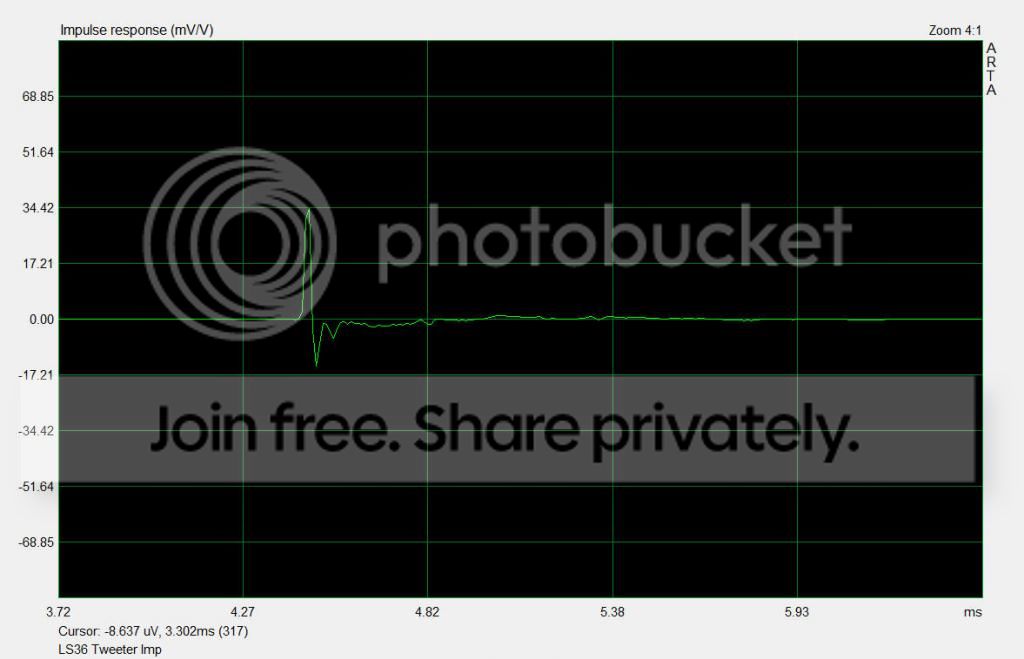
Okay now I admit, if I wanted to really confirm my assertion I need to take the same tweeter and put it in a non-DXT waveguide and do an a/b comparison. The impulse response is, as far as I can tell, the only place these tweeter are less than superb though. Anyway, they are going to my sister!
Happy listening over the holidays chaps
magnesium dome with DXT waveguide. On paper these look superb - the distortion is really very low. They basically take the motor of a very good tweeter (the 27TBFC) and use a stiffer dome and add a waveguide. The waveguide is special because it is the first to implement controlled diffraction to widen the top end dispersion. It works well, the waveguide narrows the low end (~3KHz) dispersion to better match mid-woofers and the diffraction rings widen the top end to give an even more airy and wider sweet-spot than a regular dome.
To make a comparison here is the frequency response on and off-axis of the standard dome 27TBFC
Here is the same measurments for the DXT - You need to ignore the rise in the middle of the range which would be made flat by the crossover. Just look at the relative levels of the off-axis responses. The top end doesn't roll away so fast off-axis and the bottom end narrows off-axis more like a woofer would.
I must say though I am not too impressed with the sound. How can that be!? It has really low distortion and good dispersion characteristics! It sounds a little rough and not focused. Certainly not bad, but not as good as the planar in the Kensai or Rob's ESLs.
I know what you're thinking, it must be the decay plot, right? The waveguide must be adding some horrible ringing. Nope! (Well not <25KHz)

Well, as always there is a good reason for subjective sound quality. It's just a case of needing to look a little closer. In a way it is the decay where this tweeter is odd, but it is over a very short time period. Lets have a look at the Impulse response.

Ahh now that is unusual! All those little spikes are the reflections from the diffraction rings. This is an aspect of the DXT waveguide I have never seen mentioned before so I thought I'd share it here. The subjective difference in sound between this tweeter and the Kensai one is indeed similar as when you add a sheet of felt around the baffle of a speaker and everything becomes more focused, intimate and calm.
By way of comparison here is the impulse response for the direct radiator tweeter in the AS3/6 speaker.

Okay now I admit, if I wanted to really confirm my assertion I need to take the same tweeter and put it in a non-DXT waveguide and do an a/b comparison. The impulse response is, as far as I can tell, the only place these tweeter are less than superb though. Anyway, they are going to my sister!
Happy listening over the holidays chaps

