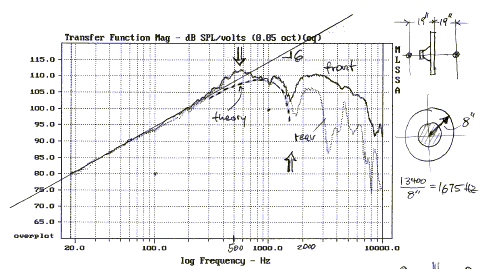
Thorsten
Just been looking at the 'JASD' thread on diyAudio, because of a reference you made in another thread (interested in building some low cost dipoles for a simple high-quality PA system application - and maybe I'll like them for hifi).
In the JASD thread, post #99 diyAudio Forums - 'JASD' (Just A simple Dipolspeaker) makes reference to the use of a "Thorsten Curve"
This post then provides the following link:Suggested target curves and setup techniques for the Behringer Ultracurve digtal
And it raises a question where I'd be interested in your answer.
The section of particular interest is:
And if so, my question is, what changed in your thinking?
Not trying to pick holes, just trying to understand what happened to cause you to change from criticising dipoles, to building them.
Thanks
Chris
Just been looking at the 'JASD' thread on diyAudio, because of a reference you made in another thread (interested in building some low cost dipoles for a simple high-quality PA system application - and maybe I'll like them for hifi).
In the JASD thread, post #99 diyAudio Forums - 'JASD' (Just A simple Dipolspeaker) makes reference to the use of a "Thorsten Curve"
This post then provides the following link:Suggested target curves and setup techniques for the Behringer Ultracurve digtal
And it raises a question where I'd be interested in your answer.
The section of particular interest is:
So, is the above quote your's? (are you the Thorsten in the 'Thorsten Curve'?)The key to much of percieved tonality is the behaviour of room and speaker though the reverbrant range, because in this range we find the fundamentals of most instruments and the human voice as well as all the harmonics. Above I commented that in reverbrant range the speaker behaves a lot like a light source.
For a long time two specific types of speakers have been sold to the unsuspecting public that have by design severe behavioural problems in this range. One type is the Full Range Dipole and the full range omnipolar speaker. Neither type is found in serious Studio or sound reinforcement applications for exactly this reason.
Dipoles and Omnipolar Speakers create way more problems than they solve, by radiating energy over a very WIDE frequency range and also a very wide area. Think simply of a naked lightbulb in a room. THis is your omnipolar speaker and to a lesser degree your dipole. this makes the frequency response in room within the reverbrant range maximally dependant on the room symetry, absorbtion etc. and thus will require major efforts on room treatment to correct for the problem. Of course, a notable minority of listeners actually likes the presentation of omni's and full range dipoles and they by all means are welcome to their preference.
And if so, my question is, what changed in your thinking?
Not trying to pick holes, just trying to understand what happened to cause you to change from criticising dipoles, to building them.
Thanks
Chris