
Groove damage from spherical styli

RobHolt

Moderator
Joined
Oct 23, 2004
Messages
4,126
Reaction score
12
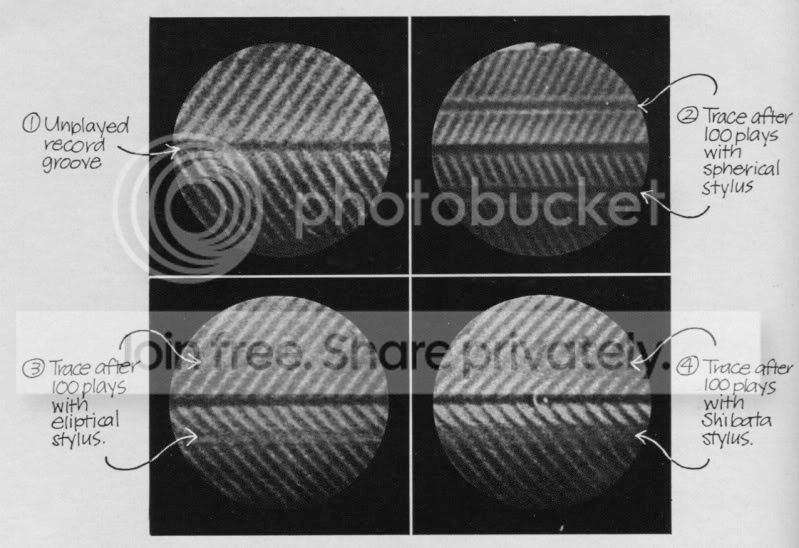
Going back into the mists a bit with this one, but in 1977 Audio Technica did some research to support the launch of their extended contact 'Shibata' stylus profile.
At the time the vast majority of styli were spherical or of basic elliptical profile.

it is well known that these simple profiles have a small footprint and therefore concentrate pressure onto a small area of the groove wall, but the AT research attempted to show the effects using an electron microscope. In this instance the cartridge used was the AT15S.

Today we have advances on the Shibata such as the Gyger, VDH and MicroRidge which lengthen the footprint even further.

These shots were taken after 100 plays:

ScannedImage2-1.jpg
 
What shape is a cutting stylus? Surely it's best to be exactly the same as that, and they could have standardized it.
 
the stylus groove cutter was always eliptical as monitored by shure as a guide on the processed vynil was tested on v15's, spherical stylus would damage grooves wether tracking force of 1.7 grams"toolight" or 2.1 gram, it will eat away info on grooves and cause a hissing rough sound on play back like tear and wear,it not take as to 100 plays to hear the diteroration of sound,
 
What shape is a cutting stylus? Surely it's best to be exactly the same as that, and they could have standardized it.

A sharp 'V'. One needs to consider that records tend not to be perfectly flat, in fact many are not even remotely flat, now couple this with the fact many carts have poor stylus azimuth, and many arms do not even allow this parameter to be adjusted and the problem becomes apparent. A stylus tip has to be a compromise between maximum groove contact and minimal damage. A sharp tip will simply recut the record.

Tony.
 
azimuth is very inportant, most dameging effect is not only tracking force, but also on vta tracking, and h.a. a.
 
A sharp 'V'. One needs to consider that records tend not to be perfectly flat, in fact many are not even remotely flat, now couple this with the fact many carts have poor stylus azimuth, and many arms do not even allow this parameter to be adjusted and the problem becomes apparent. A stylus tip has to be a compromise between maximum groove contact and minimal damage. A sharp tip will simply recut the record.

Tony.

VDH did much research on this and their tips go no finer than 2.5 microns IIRC. Finer risks cutting the vinyl.
The standard ones are 3.5 as are the MR tips used by Dynavector and AT.
Most spherical and elliptical are far too wide at 8um+ and you can clearly hear the HF distortion from the centre of the record onwards.

The issue here is the major radius as that determines the length of the footprint.
Minor can be seen as influencing HF quality (finer the better) and major the contact area (stylus/record life).

Good FL tips these days are in the the region 3.5um x 40um - fine HF tracing and low wear.

The AT15 used in the AT test tracks at between 1.50 and 2.00g and was available with Spherical, elliptical and Shibata.
I've got a mint one with Shibata tip and it does sound very good.
 
Just a thought, but what record groove exactly are their artists impression of a record groove meant to mimic. That's not like any groove I've ever seen under high power.

Surely that's just to show the effect of a stylus dragged through a patterned impression, that's not how carts go through grooves though, is it?
 
Just a thought, but what record groove exactly are their artists impression of a record groove meant to mimic. That's not like any groove I've ever seen under high power.

Surely that's just to show the effect of a stylus dragged through a patterned impression, that's not how carts go through grooves though, is it?

Looking at the pattern i'd say that is a single tone, so likely a test disc.

It would be difficult to show the wear with a complex signal, though the same forces are at play so i wouldn't see that as an issue.

What they are demonstrating is nothing more than common sense if you think about it.
Records undoubtedly wear out with repeated playing - noise increases and HF falls away.
Spreading the pressure over a wider footprint must reduce wear....
 
Hi,

I have read about Shibata stylus tips. I use a Ortofon Jubilee that has a shibata tip.

The Shibata was developed by Norio Shibata of JVC around 1972. JVC had developed a Quadrophonic system, the CD-4 that had a carrier frequency up to 50KHz.

Elliptical stylus would struggle at these extremes plus increase wear & tear. The Shibata tip was fitted to Quadronphic cartridges due to its ability to track very high frequencies with a lot less wear. It was also added to stereo cartridges for the extra performances.

Companies like Audio Technica fitted the Shibata to their cartridges.

Soon, other companies brought out variations such as the Stanton / Pickering Quadrahedron. The Fashion for Quad sound died ouit. This lead to the stereo version, Stereohedron which was the first of the line contact (after the Shibata)

The next development came from videodisc developments in the 80s. These were the "ridge" shaped tips. These were developed by Namiki in 1985. Fitz Gyger also produced a version in 1989.

As Rob as pointed out, The Shibata (& off shoots) give less wear & tear. Test were done to show that even on a worn record played using a spherical tip & high tracking force, a shibata tip will play the record nearly as new.

http://www.johana.com/~johana/dorren/cd-4paper4.pdf

look at pages 6 to 9.

SCIDB
 
dean, what about at's micro linear stylus? as they said was an inpruvement on the shibata, claimed on the latest oc9 ml/111 latest?
 
Sadly many of the new AT MCs don't have the ML. A real shame IMO as it made the middle of the range MCs special, but I imagine it pushes the cost up quite considerably.
The top AT33R still has it but that's twice the cost of the 33PTG.

I suspect i'll end up with a 33R next year when the PTG wears out, or perhaps another Dynavector DV17 as the system is now neutral enough to carry it.

Micro Linear and Micro Ridge are essentially the same thing. I like them as they maintain performance over a longer period than other profiles. As the ridge wears the profile is maintained - the tip just sits fractionally lower in the groove.
Instead of gradual worsening of tracing at HF you get a long and consistent life, then they die pretty quickly.
 
We should perhaps compile a list of currently available microline tipped carts. I have to admit that after living with the 33PTG for a while I'll not want to make any sacrifices in end of side tracking when I come to replace it. It's got at least a year left I reckon.

Tony.
 
Good idea Tony.

Off the top of my head and in ascending price order:

AT440MLa - Nice clean MM selling for £150-ish. Toppy though.

AT33R - Current top of the range and effectively a slightly improved PTG but at twice the price, around £600 on import.

Dynavector DV17/3 - Probably unbeatable at any price if you can balance it in the system. This is another of those cartridges that inflation has passed by. The Karat cartridges were alway near the top of the tree cost-wise in the market. Now they occupy the middle rungs despite being a lot better. About £700 these days IIRC.
 
Dynavector DV17/3 - Probably unbeatable at any price if you can balance it in the system. This is another of those cartridges that inflation has passed by. The Karat cartridges were alway near the top of the tree cost-wise in the market. Now they occupy the middle rungs despite being a lot better. About £700 these days IIRC.

I tried a DV17/D2 at one stage and thought it had no bass at all. Not for me! Nice mid and top, just no bass or grunt.

I'm pretty sure there are some Ortofons with fancy tips, e.g. the 2M Bronze and Black MMs and some of the better MCs. The ATOC9 has a microline tip too IIRC, as does the AT150MLX.

Tony.
 
Apparently this cart responds well to being loaded at around 32K rather than 47K. I hope to get my hands on one in the near future to try out.

Stuart.
This is one of the continual misinformations that just keeps getting passed around forums. It started because of people using SUTs for MC gain with valve pre-amps and has continued to be perpetrated like a disease

Just think for minute what loading means. It is an interface between two parts and this doesn't only depend on one part of that interface. So bonzo "A" finds cartridge "B" works best at 32k ohms with pre-amp "C" so you get a blanket recommendation that bares no relationship with the interface the punter "D" is thinking of using it with.

This is because very few phono stages reject load, (I have explained this many times on other forums). Some do to a greater or lesser degree, but I know of one :D that does it almost completely.
 
Worth mentioning that the toppiness of the AT440Mla improves a bit with 30 to 35 Kohm loading and I'll vouch for that.

if you disagree then revert back to the 45Kohm loading and no harm done
 
Worth mentioning that the toppiness of the AT440Mla improves a bit with 30 to 35 Kohm loading and I'll vouch for that.

if you disagree then revert back to the 45Kohm loading and no harm done
As I say, its a disease. If you cannot qualify by saying whats on the other end of the interface you are just giving false information.
 

Latest posts

Back
Top