
You are using an out of date browser. It may not display this or other websites correctly.
You should upgrade or use an alternative browser.
You should upgrade or use an alternative browser.
measurement bollocks.
- Thread starter sq225917
- Start date

RobHolt
Moderator
- Joined
- Oct 23, 2004
- Messages
- 4,126
- Reaction score
- 12
So do I.
I really like the Rogers Export Monitors I'm using at the moment.
Big old BBC based designs with the twin tweeter system.
On axis they have some lift up at the very top and a wee dip a bit further down. Subjectively I seem to prefer that to ruler flat.
The reason I bang on so much about measurements is that, in this example for instance, I've identified a particular sound balance that I like and been able to confirm the causes via measurements.
That's very important as I'm designing a modern BBC style monitor at the moment and some understanding of what I've measured in that old Rogers will be extremely valuable, potentially avoiding much time wasting and pissing in the wind further down the line.
Im not measuring my preference, I'm measuring the factors that form it.
I really like the Rogers Export Monitors I'm using at the moment.
Big old BBC based designs with the twin tweeter system.
On axis they have some lift up at the very top and a wee dip a bit further down. Subjectively I seem to prefer that to ruler flat.
The reason I bang on so much about measurements is that, in this example for instance, I've identified a particular sound balance that I like and been able to confirm the causes via measurements.
That's very important as I'm designing a modern BBC style monitor at the moment and some understanding of what I've measured in that old Rogers will be extremely valuable, potentially avoiding much time wasting and pissing in the wind further down the line.
Im not measuring my preference, I'm measuring the factors that form it.

bottleneck
talks a load of rubbish
On the crossover, the same basic things apply though there is more chance of a real difference emerging, so all the more reason to be sure.
You probably improved the layout within the negative leg of the crossover when you soldered it up. My lash-up at your place was to get the circuit working with the tools and methods on hand.
.
...for which I remain extremely grateful of course
 You got me out of a pickle.
thanks once again

TonyL
Club Krautrock Plinque
did not the quad 405 had the worst measurements on paper ? yet was an icon in the industry of sound reproduction!
IIRC it was quite good from a measurement perspective, but poor on current delivery, i.e. not suited to many of the real amp-sucker speakers of the time (e.g. Kef 105, Linn Sara, Gale 401 etc). It was however a superbly reliable amp and will have been used on many of your favourite records as most studios ran a 405 into nice easy to drive Tannoy SRMs as the full-range monitors.
Here's a picture of Abbey Road in the early 70s:
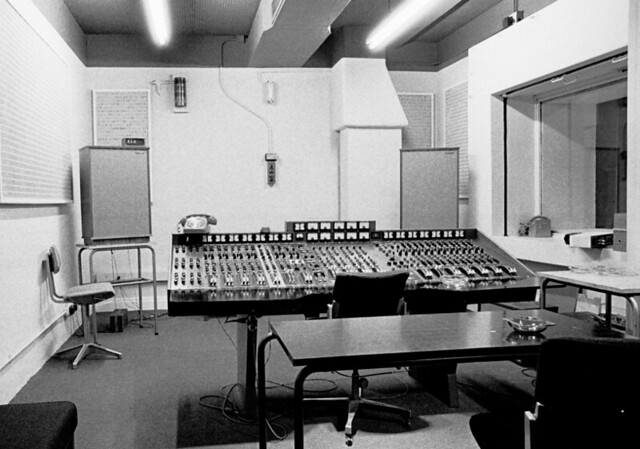
Speakers are Tannoy Lancasters (15" Monitor Golds), notice the Quad amp sitting on the carpet underneath the speaker, I assume it's a 50E rather than a 303 purely due to where it's sitting. This would have been before the 405 was released. I've been in plenty of studios that used either 303s or 405s for both the full-range and near-field monitors. They were bullet/idiot-proof amps.
Tony.

- Joined
- Jul 22, 2005
- Messages
- 222
- Reaction score
- 0
Are those casters on the legs of the stands? And look at that wire just trailed across the floor, and the telephone on the desk!!!
And fluorescent lighting!!! For the love of god!!!
I just don't see how anything recorded there could be any good at all...
And fluorescent lighting!!! For the love of god!!!
I just don't see how anything recorded there could be any good at all...
RobHolt
Moderator
- Joined
- Oct 23, 2004
- Messages
- 4,126
- Reaction score
- 12
...for which I remain extremely grateful of course
thanks once again
No problem Chris, it was a very enjoyable day
Did you up-spec the indictors in the end or keep the existing ones?
quote
lovelly pic, i do believe it is a 50E, do you know what year that was? i think late 50's?
IIRC it was quite good from a measurement perspective, but poor on current delivery, i.e. not suited to many of the real amp-sucker speakers of the time (e.g. Kef 105, Linn Sara, Gale 401 etc). It was however a superbly reliable amp and will have been used on many of your favourite records as most studios ran a 405 into nice easy to drive Tannoy SRMs as the full-range monitors.
Here's a picture of Abbey Road in the early 70s:
Speakers are Tannoy Lancasters (15" Monitor Golds), notice the Quad amp sitting on the carpet underneath the speaker, I assume it's a 50E rather than a 303 purely due to where it's sitting. This would have been before the 405 was released. I've been in plenty of studios that used either 303s or 405s for both the full-range and near-field monitors. They were bullet/idiot-proof amps.
Tony.
lovelly pic, i do believe it is a 50E, do you know what year that was? i think late 50's?
TonyL
Club Krautrock Plinque
lovelly pic, i do believe it is a 50E, do you know what year that was? i think late 50's?
It's apparently early 1970s. The 50E only existed a year or two before the 303, so the pic is late 60s at the very earliest.
Tony.
RobHolt
Moderator
- Joined
- Oct 23, 2004
- Messages
- 4,126
- Reaction score
- 12
IIRC it was quite good from a measurement perspective, but poor on current delivery, i.e. not suited to many of the real amp-sucker speakers of the time (e.g. Kef 105, Linn Sara, Gale 401 etc). It was however a superbly reliable amp and will have been used on many of your favourite records as most studios ran a 405 into nice easy to drive Tannoy SRMs as the full-range monitors.
Here's a picture of Abbey Road in the early 70s:
Speakers are Tannoy Lancasters (15" Monitor Golds), notice the Quad amp sitting on the carpet underneath the speaker, I assume it's a 50E rather than a 303 purely due to where it's sitting. This would have been before the 405 was released. I've been in plenty of studios that used either 303s or 405s for both the full-range and near-field monitors. They were bullet/idiot-proof amps.
Tony.
My first experience of the 405 was doing a weekend job back in my teens at a little East London studio, East Street. Now long gone but stuffed full of great kit from Tannoy & Revox, plus a single Quad 405 beneath the main desk doing main speaker monitoring duties. I can't recall the main Tannoys but having seen a few since I'd say they were SGM or SRM or possibly mid sized units using HPDs, with the obligatory little Auratones perched on the desk proper.
Fantastic times and of course a great opportunity to hear live v recorded sound.
Mostly recorded Reggae and small rock bands.
Anyway, onto the 405 proper, the only potential issue with the Mk1 was restricted current output as you say. However it was enough for the amplifier to deliver full spec into >5 ohms. A 405 has very low output impedance (0.03 ohms), worst case THD at 0.05% and also very low IMD though I've not the figure to hand. All other specs are comparable to a decent SS amp built today, but the ace up the sleeve is that it doesn't drift with operating time (temp) or age, within reason.
Strip out residual hiss from the THD measurement and relax the upper frequency limit to 15khz and 0.003 is a typical figure. Very low in other words.
The later 405-2 relaxed the current limiting and the amp will now drive 4 ohm loads perfectly well, but will also deliver 50w into any load just shy of a short circuit. Worth mentioning as many amps with high power ratings just shut down under such punishment.
The problem with amplifiers such as the 405 or the bigger 606/909 is that for many they represent game over. The goal of reducing amplifier distortion to below audibility has been reached. Walker went even further and claimed that the 405 was designed to provide higher SPL and improve reliability/consistency. No claims were made that it sounded better than the older 303.
To take that argument further we have to look at the expectations of the target market. Quad were unfortunate in this regard in that much of their market were on the one hand professional users, were quite different methods of assessment are at play, non audiophile music lovers with no interest in the latest hi-fi 'hobby' announcements, and on the other hand the specialist home audio fraternity for whom a more than competent capable amplifier, in a small case and at a reasonable cost represents complete anathema. What is there to write about, fill subjective audio columns with etc when it's a case of job done?
The old adage of turkeys voting for Christmas comes to mind.
Of course none of this matters if what you seek is an amplifier that imposes character of signature onto the signal. Nothing wrong with that position so long as listeners recognise that any subjective benefit isn't derived from some innate goodness within the amplifier, but simple manipulation of measurable performance to create effect.
The case I've mentioned before of Lowther drivers sounding better with relatively poorly specified SET amplifiers is a good example. A 'failing' within the amplifier is mitigating a characteristic within the speaker and the overall result is subjectively more pleasing.
That is fine but such cases are small in number, and there are arguably other ways to give a similar result.
For me, future amplifier development is about improving efficiency, and increasing output capability, with secondary consideration being reducing costs and improving the provision of facilities. Those are the only areas where progress is possible IMO.
That picture has led me to http://www.tgmixers.co.uk/Frames/frameset.htmlHere's a picture of Abbey Road in the early 70s
Wallow.
Paul

sq225917
Exposer of Foo
- Joined
- Jan 11, 2007
- Messages
- 1,514
- Reaction score
- 0
But the 405's sound crap, washed out, dull, lacking in dynamic swing ability, the speed it swings between micro and macro is poor- despite it's average measurements elsewhere and poor current delivery.
Some may say it doesn't impose character onto what it plays, others simply don't like the way it sounds.
Some may say it doesn't impose character onto what it plays, others simply don't like the way it sounds.
It's apparently early 1970s. The 50E only existed a year or two before the 303, so the pic is late 60s at the very earliest.
Tony.
I think they were Monitor Reds actually.
RobHolt
Moderator
- Joined
- Oct 23, 2004
- Messages
- 4,126
- Reaction score
- 12
But the 405's sound crap, washed out, dull, lacking in dynamic swing ability, the speed it swings between micro and macro is poor- despite it's average measurements elsewhere and poor current delivery.
Some may say it doesn't impose character onto what it plays, others simply don't like the way it sounds.
In your opinion.
I've heard Audiolab and TAG described in very similar terms - also incorrectly by people prone to believe everything they read.
it sounds quite different when it cannot be seen (just like the Audiolabs), and if anyone requires proof I'll gladly demonstrate that against their chosen amp.
Genuine offer to anyone willing to use just their ears, just send a PM.
Moving on, Harman and their testing has been mentioned in the thread so here's a link to the guy's blog:
http://seanolive.blogspot.com/2009/04/dishonesty-of-sighted-audio-product.html
But the 405's sound crap, washed out, dull, lacking in dynamic swing ability, the speed it swings between micro and macro is poor- despite it's average measurements elsewhere and poor current delivery.
Some may say it doesn't impose character onto what it plays, others simply don't like the way it sounds.
Into a a pig of a speaker - loadwise - they might sound crap.
Into a relatively easy load such as EV Sentry III's they sound fine. 303's sound fine too into this speaker.
sq225917
Exposer of Foo
- Joined
- Jan 11, 2007
- Messages
- 1,514
- Reaction score
- 0
Thing is Rob, I knew nothing of the hifi press when i had a pair of 405's I was given them by my brother, and he'd never mentioned anything about the way they sounded. There were no forums and I didn't read hifi magazines.
They just sounded dull, and flattened compared to the sony Esprit stuff they were meant to replace. They didn't replace the Sony amp they were moved on instead. Esprit TA900 something or other, lovely thing.
They just sounded dull, and flattened compared to the sony Esprit stuff they were meant to replace. They didn't replace the Sony amp they were moved on instead. Esprit TA900 something or other, lovely thing.
sq225917
Exposer of Foo
- Joined
- Jan 11, 2007
- Messages
- 1,514
- Reaction score
- 0
Not sure how they measured, wasn't interested in such thing at the time, I was only a teenager. It did play Stiff Little Fingers spectacularly, and the Cramps, as well as a selection of my old man's classical vinyl. All decent wideband Decca or good HMV and Mercury stuff.

YNMOAN
Trade - AudioFlat
- Joined
- Jul 16, 2007
- Messages
- 674
- Reaction score
- 0
Those were the 'proper' ES amps, not the much more mass-market ES stuff that followed (and which Sony fans go all soft over).
__________________
I've listened to the Quad 34 and 306 ,mamy, many times (to a lesser extent the 44 and 606). To be honest, they never struck me as neutral, quite the opposite in fact - rather veiled and lacking in micro/macro dynamic; nicely made and good features though. I didn't have to read a magazine to learn this, it was easy enough to hear for myself.
__________________
I've listened to the Quad 34 and 306 ,mamy, many times (to a lesser extent the 44 and 606). To be honest, they never struck me as neutral, quite the opposite in fact - rather veiled and lacking in micro/macro dynamic; nicely made and good features though. I didn't have to read a magazine to learn this, it was easy enough to hear for myself.
TonyL
Club Krautrock Plinque
I've listened to the Quad 34 and 306 ,mamy, many times (to a lesser extent the 44 and 606). To be honest, they never struck me as neutral, quite the opposite in fact - rather veiled and lacking in micro/macro dynamic; nicely made and good features though. I didn't have to read a magazine to learn this, it was easy enough to hear for myself.
Far better to consider the power amps separate from the preamps IMO. I've heard 303s and 405s sound staggeringly good in studios, so they are capable amps given sufficient quality upstream and something easy to drive downstream. In my second system (303 / Klipsch Heresy) I certainly prefer my Audio Synthesis PAS 02 to my (early type but recently serviced) Quad 34. It's just more open, freer and lets more information through. It's next to no pre really, just being a fancy stepped attenuator and input selector. The 303 has tons of gain (0.5v for full output) so it just doesn't need an active pre IMO.
Tony.