Opinions re Mission Mechanic Tonearm and NOW Rega RB 1000

Joined
Apr 16, 2007
Messages
31
Reaction score
0
Hi folks,
I have the chance to obtain a Mission Mechanic tonearm (to fit on Linn LP12) that is boxed/excellent condition and am seeking genuine opinions on its abilities, seeing as its a vintage piece (circa 1986). Also, what would be a fair price?

Cheers, Keith.
 
Last edited by a moderator:
Made for Mission by the same people (GB Tools) who made the Zeta tonearm. Cost around £400 when new (mid 80's)

Heavyweight beast of a thing. I'm not convinced an LP12 would be the best platform for it.
 
Hi Murry, too heavy for the Linn was my first thought, but a search on the 'net shows that a number of people have had very good results!? Yes, it is a relative of the Zeta, and quite similar in design, which I see regularly sell in good condition for about £350. I suppose this Mechanic is worth £500, at the very tops, as they seem rare secondhand.
 
Not really a weight issue. Arms such as the Zeta, Mission and even the SMEV can be quite revealing of the turntable on which they are mounted. People have certainly tried fitting the Zeta to the LP12. I heard this combination a few times but it was never a very happy marriage imho. Ditto the SMEV.
 
a lot were sold on xerxes ,

thay are brilliant arms but the bearings are ceramic and were easily damaged.

a true underground classic arm.

imho.
 
Thanks for your comments folks. The seller wants more than £500 for his example. So unless someone here is keen to sell (plug, plug) at about this price, I will have to examine other options.

Cheers,
Keith.
 
Last edited by a moderator:
The Mechanic was indeed manufactured by GB, the designer Mick Gray also built the Zeta. The Mechanic had a total production run of circa 225 of which around 50-100 had the ceramic bearings, later issues had abec bearings and had better quality control. Second hand mechanics (if you can find one.....) should go for around 500-800 quid, although I have seen them go for more.


As for LP12 compatibility, you should have no real problems, the mechanic uses the Linn 3 point fixing and works well with the Linn. The Mechanic was designed with Decca or low compliance Carts in mind.

Incidentally, Mick made a few limited versions in Titanium and Steel for a few fans......These days he makes a few arms now and again which are scaled up mechanics......


Sound Quality wise, the Mechanic is still an underated classic Tonearm and is well worth hunting down.


VN
 
Hi VN:

But is it better than a Sumiko MDC-800, which sells for around $900 (£450) States (USA) side?
 
I think the mechanic is a far better sounding arm than the Sumiko (but thats just my opinion....I have heard the MDC....). As a caveat, in my experience the Mechanic (and the Zeta) works better on a non suspended deck...although both do well on LP12's, Gyrodecks etc.

Generally the Mechanic 'sound' is dynamic, clean, punchy and nuetral, a classic late 80's analog sound really, but without the bass bloat of other contemporary arms. Its a better arm than any Linn offering and is very well built.


If you do decide to purchase, check the wiring and any bearing rattle....some early mechanics suffered from poor QC...the ceramic bearings were hard to keep consistant in assembly
 
Not really a weight issue. Arms such as the Zeta, Mission and even the SMEV can be quite revealing of the turntable on which they are mounted. People have certainly tried fitting the Zeta to the LP12. I heard this combination a few times but it was never a very happy marriage imho. Ditto the SMEV.

Hi,

I'm sure Jimmy Hughes had a Mission mechanic on his Linn LP12 back in the 80s.

SCIDB
 
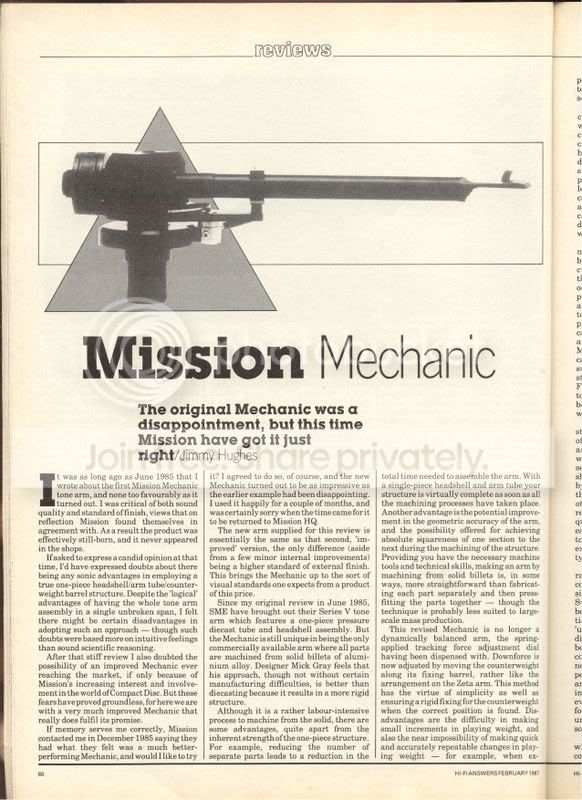
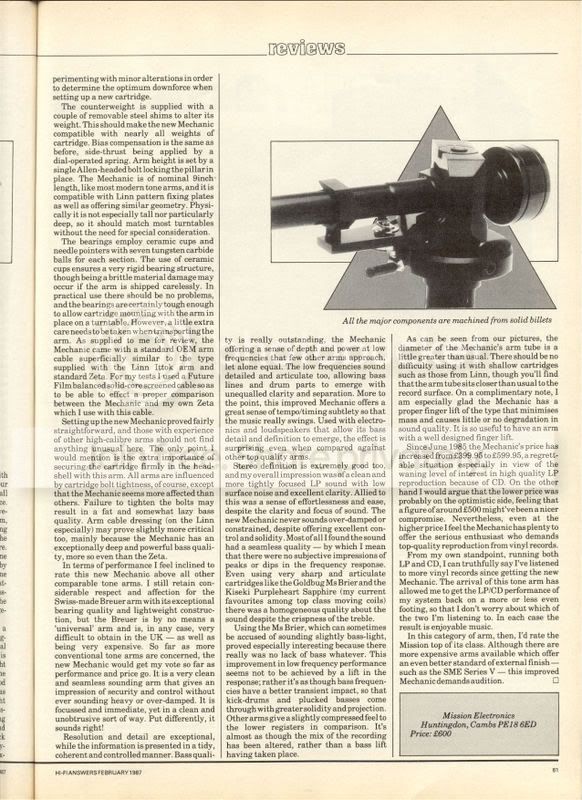
Jimmy did indeed own a mechanic and wrote a very positive review in HiFi Answers


if any one is interested I can post a scan of the article:)
 
Hi again VN:

If the Mechanic was so good why did so few sell. I believe when new it wasn't that much costlier than the Zeta, which sold fairly well?

Please post Jimmy's article, that would be interesting.
 
rp1.jpg


rp2.jpg


the mechanic was spoiled by Mission's lack of interest in analogue, despite that the mechanic did sell well at its price of 900 quid when it was discontinued
 
Hi Murry, too heavy for the Linn was my first thought, but a search on the 'net shows that a number of people have had very good results!?

I used a Zeta for a good while when I had an LP12, it's a similar physical weight to the Mechanic. It is certainly possible to use either arm on an LP12, but I'd argue that the owner needs to be competent at setting the deck up themselves as the back subchassis spring does end up taking far more weight than it was designed to. This means the lateral movement of the subchassis is significantly compromised compared with how it is set with a light arm such as an Aro – it means if the subchassis moves over time (which they do) then the rear grommet often starts rubbing and the deck squeaks or fouls up when it bounces. I found I had to reset my deck every few months which was irritating to put it mildly. The upside is it sounds excellent. I remember having a three way dem of Aro, Ekos and Zeta on a Linn and preferring the latter by far – it's a PITA to set up but it does sound great. I believe the Mechanic is very similar.

I understand there are different versions of the Mechanic – later ones apparently had ceramic bearings, ISTR there was some debate as to which version sounds best, i.e. some preferred the earlier metal bearing version.

Tony.
 
Tony, the early mechanics had ceramic bearings which were found to be unreliable and inconsistant in manufacture.....the second generation arms with standard bearings do sound better....I know, as I have samples of both.
 
Ah, thanks - I am obviously travelling the wrong way in time! It's an arm I've never heard though always fancied. I had the cheaper 774SM for a while and that was a nice arm too. It was also made by GB Tools but a lot lighter so one could easily set the Linn up.

Tony.
 
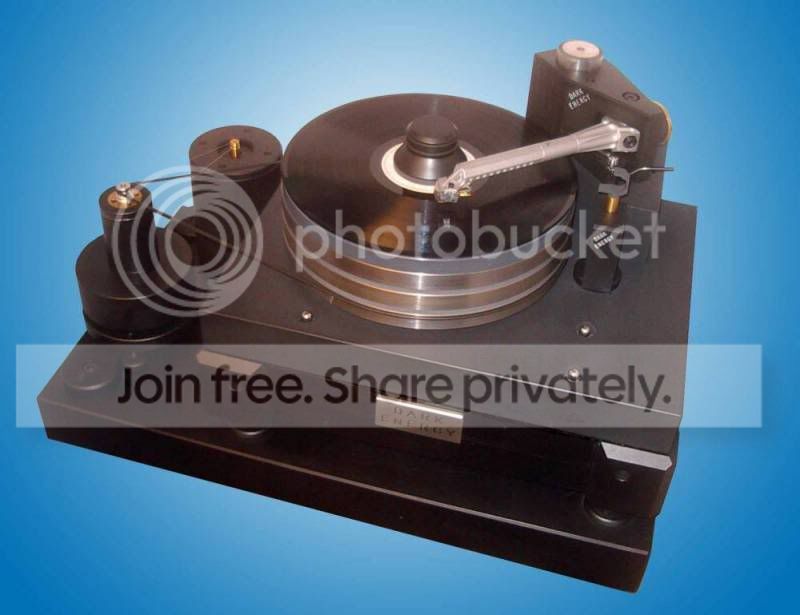
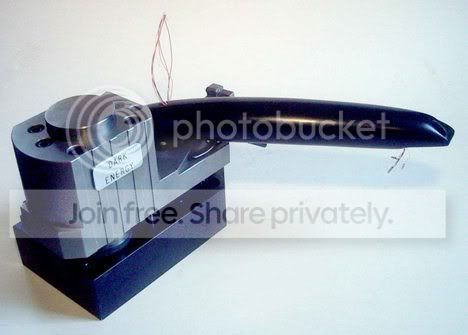
Another Mick Gray creation afaik.

darkenergy.jpg


Homemade turntable. Weighing 200 kilos. The chassis is made from lead.crushed granite and slate
mixed with epoxy resin.The platter is laminated from steel and PVC and weighs 38 kilos. The motor is a 24v dc with skewed armature driving a 10 kilo flywheel which runs at 600rpm,this drives the platter.The armtube is made from one piece of solid aluminium,and retained in a massive steel bearing housing.
This took 3 years 6 months to make.
 

Latest posts

Back
Top