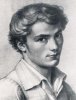
Franz Schubert's (1797–1828) best friends were the brothers Anselm and Josef Hüttenbrenner from Graz. Schubert dedicated "The Trout" quintet to Josef, the younger brother. He and Schubert lodged together for a time in the same house, and he was responsible for collecting together many songs that would otherwise have been lost. Anselm met Schubert while they were both pupils of Salieri, and he gave up the study of law to devote himself to music. When his father died in 1821 he moved to the family property in Graz, and visited Vienna only one more time during Schubert's lifetime. Another close friend was Johann Mayrhofer, with whom Schubert shared the same room in Vienna for two years, when Schubert was twenty-seven and Mayrhofer was seventeen. Mayrhofer wrote the text for many of Schubert's songs. In 1816 Schubert expressed terror at the idea of marriage, and virtually all of his social life was spent drinking with fellow male students and musicians. His contemporaries acknowledged that he led a riotous bohemian life but that he was also misogynistic, which some modern interpreters have seen as a veiled allusion to his participation in the gay subculture of Vienna. In late 1822 some friends persuaded him to visit a brothel, where he contacted syphilis (presumably from a female prostitute) which put him in hospital the following year and lead to his death five years later. Tragic despair informs his "Unfinished Symphony" and the Winterreise song-cycle during these painful last years of his life. His friend Mayrhofer took his own life a few years after Schubert's death.