
Just messing about with my cd player, which has cone feet glued to the bottom. Ive had the cd sitting on a thick asda chopping board , as my glass rack seems to have various issues with vibrations. I had some of David Fs cone feet sitting around and so tried putting the chopping board (with cd player on top) on top of the cones and ball bearrings. The improvement was immediate. Why is this?

You are using an out of date browser. It may not display this or other websites correctly.
You should upgrade or use an alternative browser.
You should upgrade or use an alternative browser.
isolation
- Thread starter banpe2006
- Start date

I used to use the Final Lab Durama Ball bearing feet to good effect.

LiloLee
Blah, Blah, Blah.........
There does appear to be something about the use of a ball bearing, as used by Naim, Stillpoint, Cerafine, Final etc.
I also suspect that the wood helps damp out any other forms of ringing.
I also like the (cheap) partially inflated tyre tube or (expensive professional) Townsend platforms.
I also suspect that the wood helps damp out any other forms of ringing.
I also like the (cheap) partially inflated tyre tube or (expensive professional) Townsend platforms.

IMO most of the ball bearing isolation will give you speed, timing, dynamic, detail and resolution but you have to be careful in what type of base they are sitting on as they can sound a bit edgy and harsh in some systems.
I found a good combination in my own system using ball bearing isolation and acrylic platform. Tried the wood thing and found them too warm sounding and lost the speed/ timing especially noticable on acoustic guitar music.
Cheers
I found a good combination in my own system using ball bearing isolation and acrylic platform. Tried the wood thing and found them too warm sounding and lost the speed/ timing especially noticable on acoustic guitar music.
Cheers

Just messing about with my cd player, which has cone feet glued to the bottom. Ive had the cd sitting on a thick asda chopping board , as my glass rack seems to have various issues with vibrations. I had some of David Fs cone feet sitting around and so tried putting the chopping board (with cd player on top) on top of the cones and ball bearrings. The improvement was immediate. Why is this?
banpe I've ben way from this for a bit now....but I'll try and talk round (tot the best of my knowledge tht is
 ) this when i'm off shift next week
I wish I could have progessed with the cones further but as I've said before a combination of aging parents (now dicky heart) and the housing crash have pulled me away.
IME the gains can be considerable to put it mildly.
Because you wanted it to be?
Nigel, nothing wrong with being a doubting Thomas if it hasn't worked for you ( i presiume you've tried it f rom your comment).
It does work in many systems though (even if not in yours or for you) so I hope you don't try to put poeple off rom giving it a go.

- Joined
- Nov 1, 2005
- Messages
- 449
- Reaction score
- 0
Just messing about with my cd player, which has cone feet glued to the bottom. Ive had the cd sitting on a thick asda chopping board , as my glass rack seems to have various issues with vibrations. I had some of David Fs cone feet sitting around and so tried putting the chopping board (with cd player on top) on top of the cones and ball bearrings. The improvement was immediate. Why is this?
Try some of those chopping boards under your speakers or stands and see what they do.

Ive spikes into carpet on a concrete floor - would they improve presentation, if on boards jimbo? also, class A - where did you get the acrylic from - homebase etc, or somewhere more exotic? cheers
I use 20mm thick Acrylic platforms with 20mm Acrylic feet. They're made bespoke for me by a friend. You can check out plastic places for quotation and ask for off cuts.
Cheers.

Hi guys,
I've deleted a couple of posts here to try and stop this thread developing into another pointless argument. No issues with your views but let's try and be constructive and friendly.
I've deleted a couple of posts here to try and stop this thread developing into another pointless argument. No issues with your views but let's try and be constructive and friendly.

- Joined
- Jun 13, 2008
- Messages
- 377
- Reaction score
- 0
HI banpe2006 A fairly cheap option,is to try Clearlight Audio cones ,three of them and the matching footers(if you don't use the footers the cones will slide about on glass;the point of the cone is rounded) I found out years ago that if you put one cone under the drive mechanism and one under the transformer/psu and the other to balance ,that this works very well . You could also try a mixture of cone types ,sharp points in different materials can also have benefits .However these should all be level ;the same height. The levelness of a CD player is just as vital as levelness in a turntable. The material clearlight use is called RDC (it's a composite ,each different element in the mix has a different resonant point and characteristic).
The Cones should be moved slightly around the base of the player
you will be amazed as i was ,just how much difference this makes to the sound .I assume its a case of fine tuning the energy drain ,and finding the points in the base of the player that have most energy in them.
Cones can be used point up too,but i have in my own set ups not liked this,but you could try this too. If it works for you who cares why?(i know some will but i don't).
I would not use any kind of block on the floor ,without the use of some way of leveling it . Remember just because it looks flat it more than likely is not. Carpet will compress unevenly and will allow rocking as will a board on tiles or a laminate/real wood floor;it will not be level. Companies such as Ixos and Perfect sound sell attachable leveling cones,spikes.
You should also try Granite and Slate but not Marble or other composits as they can ring under certain frequences (Granite and Slate can to but they are denser). Remember that the thicker the material the better ,you should however not forget that the thickness will alter the height your tweeter and drive units are at.This is important and you should try to avoid lifting your speakers to high.
These materials can also be used under CD Players ,butchers blocks are popular as they are a lamination of criss crossed material,but the density and ability of the material to transmit vibration etc,will vary depending on the quality of wood used,density and its thickness.
Just remembered another option acoustic steel,Custom design make isolation platforms,which have ball bearing terminated footers.They call them I Raps ,they work quite well too.
Isolation is a fairly easy thing to play around with and is a fun and creative process ,you will be surprised by what works and sometimes by what doesn't .
Bottom line have fun ,Regards D Louth
The Cones should be moved slightly around the base of the player
you will be amazed as i was ,just how much difference this makes to the sound .I assume its a case of fine tuning the energy drain ,and finding the points in the base of the player that have most energy in them.
Cones can be used point up too,but i have in my own set ups not liked this,but you could try this too. If it works for you who cares why?(i know some will but i don't).
I would not use any kind of block on the floor ,without the use of some way of leveling it . Remember just because it looks flat it more than likely is not. Carpet will compress unevenly and will allow rocking as will a board on tiles or a laminate/real wood floor;it will not be level. Companies such as Ixos and Perfect sound sell attachable leveling cones,spikes.
You should also try Granite and Slate but not Marble or other composits as they can ring under certain frequences (Granite and Slate can to but they are denser). Remember that the thicker the material the better ,you should however not forget that the thickness will alter the height your tweeter and drive units are at.This is important and you should try to avoid lifting your speakers to high.
These materials can also be used under CD Players ,butchers blocks are popular as they are a lamination of criss crossed material,but the density and ability of the material to transmit vibration etc,will vary depending on the quality of wood used,density and its thickness.
Just remembered another option acoustic steel,Custom design make isolation platforms,which have ball bearing terminated footers.They call them I Raps ,they work quite well too.
Isolation is a fairly easy thing to play around with and is a fun and creative process ,you will be surprised by what works and sometimes by what doesn't .
Bottom line have fun ,Regards D Louth
Last edited by a moderator:
- Joined
- Nov 1, 2005
- Messages
- 449
- Reaction score
- 0
Ive spikes into carpet on a concrete floor - would they improve presentation, if on boards jimbo? also, class A - where did you get the acrylic from - homebase etc, or somewhere more exotic? cheers
Perhaps in your case they may not make as much differance as it did for mine. I have a suspended wood floor. For how much they cost it wont break the bank. Wife could always use them for chopping boards in the kitchen.
HI banpe2006 A fairly cheap option,is to ..............is a fun and creative process ,you will be surprised by what works and sometimes by what doesn't .
Bottom line have fun ,Regards D Louth
An interesting post DL.
Just a few thoughts to get started again with this.
I experimented a fair bit using oak cones with a ball bearing inserted into the top something like this...
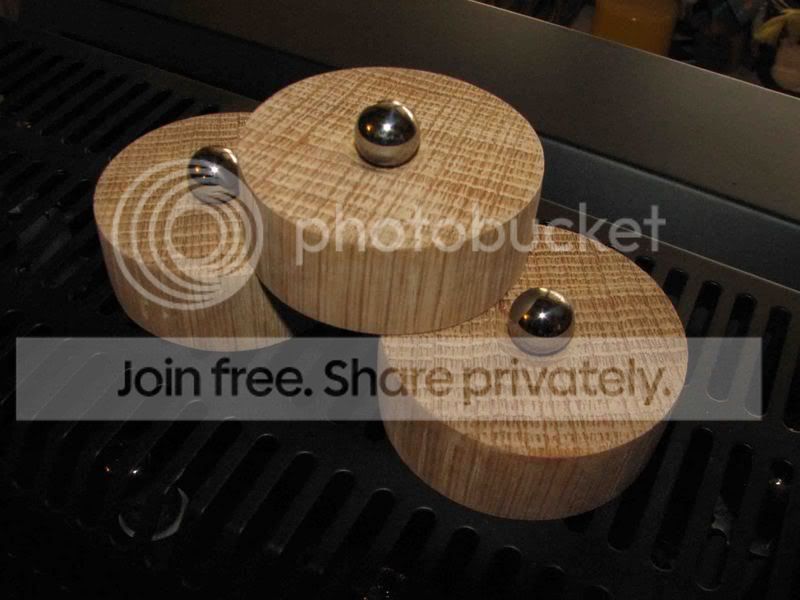
except I now sit the balls far further into the cone than is these examples.
i hope i don't too sad an iNdividual for this but I was having quite a play with this.....
a few observation....IMO....
1) the surface between the ball and the cone.....its worth getting it really smooth. I was experimenting with a dremmel....getting a nice polished surface........but still retaining....the shape of the ball...
ie a precise semi circle
2) I was using a router with semii circuler router bit (they are not common...it was only by chance that my dad saw one in a catologue whilst talking to a friend).
3) believe it or not the SIZE of the ball is an influence. Sleuthing on the net IIRC revealed that somewhere between a 16 and 19 mil ball is ideal. The bigger balls will tend to enphasise the bottom end.......a smaller ball the top end.
4) a good coat with beas wax(the cone not the ball) seemed to pay dividends. Frankly I'm not precisely sure on why....I presume going down the "light and rigid" philsophy.
5) I was sinking the balls into the cones half way ...this is really tricky to get right....and important to get right, as you need all the cones level at the end of the day.
A few further thoughts....
spacing under the player.....I did read that the best place to put the cones is butting against a protruding screw or nut or whatever....this will be the site if maximum vibration drain
I was using chrome balls ...or whatever i could get at a sensible price......again, I read that Titanium (I think) is the ideal material......but the balls come out at about 5 quid each. Thats a bit rich for me.
Banpee as I understand it, the general idea is to...,
1) Drain mechanical energy away from the cd player (done by a combination of absorbtion by the oak cone......and vibration of the ball within its seat)
2) prevent (or minimise) the feed back of acoustic energy into audio equipmment.
thats all I can think of for now.
If this is all sounds a bit pedantic......IMO the rewards are there....if you enjoy playing with these things.
Sorry my notes are not exactly structured......just stuff off the top of my head.
Now wait for the .....its no good it can't work coments!!
Sorry only kidding
Last edited by a moderator:
DavidF, Have you tried tungsten and bronze balls???? maybe worth a try.
I'll look into it.
Thanks.
DavidF,
Try these sites out:
http://www.dejaydistribution.co.uk/index.html
http://66.102.9.104/search?q=cache:...gsten+ball+bearings&hl=en&ct=clnk&cd=21&gl=uk
A bit of read up on isolation: http://www.gcaudio.com/products/reviews/infoisolationoverview.html
Try these sites out:
http://www.dejaydistribution.co.uk/index.html
http://66.102.9.104/search?q=cache:...gsten+ball+bearings&hl=en&ct=clnk&cd=21&gl=uk
A bit of read up on isolation: http://www.gcaudio.com/products/reviews/infoisolationoverview.html
Bob McC
living the life of Riley
DavidF
Looking at your pictures you seem to be using an unfamiliar definition of the word cone.
Looking at your pictures you seem to be using an unfamiliar definition of the word cone.
- Joined
- Jun 13, 2008
- Messages
- 377
- Reaction score
- 0
Hi DavidF ,sorry i could not reply to your posting as my internet crashed earlier today. Glad you like my posting . The positioning of cones is something i discovered for myself about 15 years ago. At that time i had (and still do a Marantz cd94 mk2) which i did a structural mod to it . I replaced the thin metal base plate with a 10 mm thick brushed and laquered aluminum plate ,with all the holes drilled to match the original . I also filled its feet with miliput a modelers clay which goes hard (imagine Arildite as a type of clay which you mix together). It didn't make sense to me why you should build a wonderful heavy die cast box into which all the bits went only to fit a thin light bottom. This improved things but the addition of three German cones placed as i said earlier also lifted the performance . I spent hours moving them back and forward until i thought it was as good as it could be ,and then glued them in place . At the same time a friend who had a Stan Curtis Cambridge Audio CD 3 did the same and i remember him ringing ever so often and not believing what this did for the sound . He ended up using Michell tender feet .
I am sure that Oak cones and RDC cones will work like this too,if you have the time and patience to play around with the positioning . If i had access to a workshop again it would be great ,as there is a lot that could be done . Your Cones with ball bearing inserts look interesting ,but as you say accuracy would be vital as everything must be level .
When i was at art college back in the late eighties and early nineties i was regularly to found making stuff in the work shops to do with audio . Isolation platforms made up of laminations of different materials and types of cones . I had this plan at the time to make a new case for my Audio Innovations 300 amp but as i was doing silver smithing and jewelery and not product design,i never got round to doing this . Oh for a nice big workshop,bench drills ,lathes etc;again!
Regards D Louth
I am sure that Oak cones and RDC cones will work like this too,if you have the time and patience to play around with the positioning . If i had access to a workshop again it would be great ,as there is a lot that could be done . Your Cones with ball bearing inserts look interesting ,but as you say accuracy would be vital as everything must be level .
When i was at art college back in the late eighties and early nineties i was regularly to found making stuff in the work shops to do with audio . Isolation platforms made up of laminations of different materials and types of cones . I had this plan at the time to make a new case for my Audio Innovations 300 amp but as i was doing silver smithing and jewelery and not product design,i never got round to doing this . Oh for a nice big workshop,bench drills ,lathes etc;again!
Regards D Louth