Linn - love it /hate it/don't care I'll argue anyway thread!

Fully agree, I have always been a cantankerous sod, but only with people who mess with me.

Praise where praise is due, if I wanted to start a cult or create a James Bond villain Ivor T would be the first place I would look for inspiration.

Regarding retailers, it is a curates egg and it was the early 90's recession that created most of the problems. Linn decided others would suffer so tied up their dealers with contracts and other big manufacturers like Cyrus etc learned from Linns lead and did the same, this killed off most of the small guys (manufacturers). Now my problem with this is that those dealer contracts are arguably illegal under the abolition of retail price maintenance and sale of goods acts. Linn were threatened with prosecution and I think the contract wording was modified but was still objected to but AFAIK the prosecution never happened.

My problem with retailers was that they took 40 to 50% of the customers price for often doing F'all and even then not paying their bills, as the manufacturers they were contracted to took all the available money. For them it was like being between a rock and a hard place, they needed to provide choice for the customer, and they needed to service the contracts from their large suppliers - the person who lost out on this was you the customer, because lack of competition meant the prices rises over the last 15 to 20 years have reached the level of piss-take instigated by these large companies when small innovative companies and competition dissapeared. I went export and virtually forgot about the UK market until the situation changed, and believe it or not it is only changing now because at last small manufacturers have direct access to their customers on-line, either direct through own websites or via ebay.

It is a new game and playing field now, and about time.

Richard,

The fact remains that many other small manufacturers grew and prospered during the FE hegemony.

Take Meridian. When Lecson Metamorphosed into Meridian, I'll bet they were no bigger than Linn or Naim.

Yet despite Linn's alleged dirty tricks (although it sounds like good business sense from where I'm looking), Meridian grew and prospered. As did A & R Cambridge, and many others.

Mostly, the firms that went to the wall did so because they failed to compete. Sometimes (mostly) it was the classic engineer/tech with a good product and no clue regarding design/marketing. Reliability was also often a problem (Nytech).

In business, you try your level best to steal your competitor's customers. If you are succesful, you will drive your competitor from the marketplace.

Linn were just very succesful.

Chris

Chris
 
Yet despite Linn's alleged dirty tricks (although it sounds like good business sense from where I'm looking), Meridian grew and prospered. As did A & R Cambridge, and many others.

Who owns those companies now?

Remember Chris, I am just the piano player, some people don't like or feel threatened by the tune.
 
Andrew, did you ever read any of the pro Linn mags?

Shocking stuff in them.

Interesting that many of the scribes writing the bile at the time spun on their heels and promptly started recommending kit they'd slagged once the arse fell out of the FE market. And I really mean slagged - anything you read in todays press or on here is nothing compared to some of the shit that passed for informed journalism.

If you'd like some evidence of borderline lunacy I'll gladly post up a few choice excerpts.

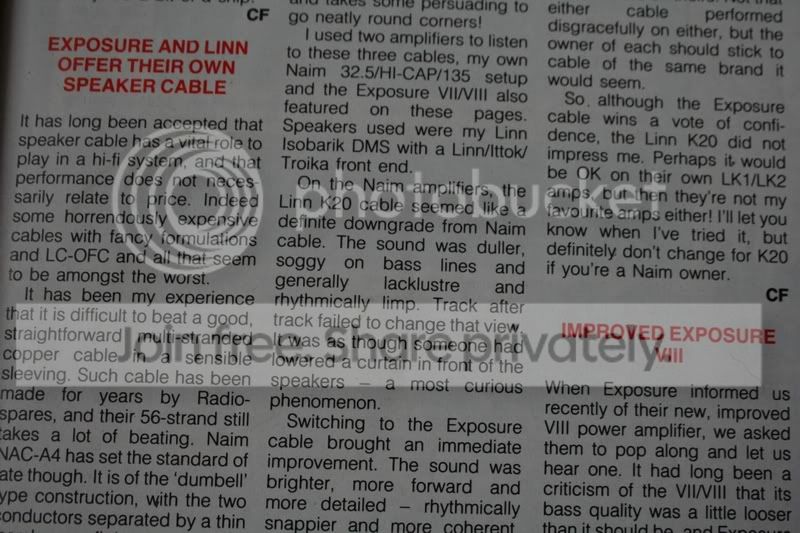
An extract from Review.

Image-37.jpg


Can anyone tell me why this is complete tosh?
 
It doesn't matter who owns them now. Back then, they were all independant, all survived the FE onslaught & prospered. They did it by competing in the marketplace.

Chris

Well they didn't then and that is why they have failed into foreign ownership (no one does this from choice).

I am about the only company from those days still in the same ownership.
 
Reminds me of the Which tumble dryer review where they gave highest marks and their recommendation to one of the most expensive dryers in the group.

Turned out they were all identical Crosslee dryers apart from the different facias (with different brand logos / fonts) and control knobs.

My housemate who worked for Crosslee's laughed his socks off over that.
 
If any hifi companies failed during the eighties it's because they were not sufficiently well skilled to compete.

Having good product is not an arbiter of success- far from it. Many sellers of shit prosper while better products fall at the wayside, look at Betamax and VHS, Betamax was far superior from a technical standpoint, but VHS was better marketed and won out.

Sometimes skill in sales and marketing is needed to help even great product succeed.
 
I don't think the skill or marketing abilities of Linn (well IT and closest) are or were in question.

What is important is what this, and the clear bias in certain sections of the press and dealerships, had on the choices people were able to make.

The Betamax example is a good one. Clever marketing caused people to buy the inferior product, which neatly brings up back to the subject of the thread.
 
But they were different colour.

Date: September 10, 1999 05:14 AM
Author: julian vereker
Subject: NACA4

Incidentally the Linn (K20?) cable was an illegal copy by BICC of our
NACA4, BICC thought that it was their design and therefore started
supplying both grey and black copies to other manufacturers including
Linn - due to a change of staff/factory I believe.

When this was pointed out to BICC, they settled out of court. We then
spent the money on designing a new and better cable with another
supplier under a secrecy agreement, and this is the NACA5.

julian

http://members.shaw.ca/mikesae/vereker.txt
 
I tolerate success, even to a degree Naims, I do not tolerate Linn, I know who they are what they are and how they did it.

I hold completely different opinions on these two companies and have plenty of respect for Naim. Don't care for all of the products, the fancy modern cabling solutions and that daft arm mostly but I've plenty of time for the electronics and the speakers are also fine if you like the very tailored sound on offer. The biggest plus is that they look after their customers and just about any product (exc some early CD mechs) right back to the old NAC12 and NAP120 period can be serviced.

The company approach to demonstrating kit is also quite different.
They just play the stuff without all that nodding, jigging about, running down the opposition or prattling-on about 'following the tune'.
 
Actually...


Betamax had a one hour record time compared to two for VHS. Not only was this more convenient for customers requiring one tape for taping a movie on VHS vs two tapes for taping on Betamax, it was far more attractive for rental businesses from a cost, merchandising and inventory standpoint. A better mousetrap in other words and nothing to do with marketing other than the consumer made the decision.

Betamax licensing and tapes cost more than VHS. A marketing choice and again, nothing to do with brainwashing. The consumer decided which format stayed and which one died. Sony made their own unfortunate choice which killed the format -not their agents.

Basically, the marketplace made the choice with VHS as it has with hifi equipment. Some of you don't give Joe Six Pack enough credit. Perceived value is damn near everything and when it comes to bang-for-the-buck, Joes collectively everywhere will usually make the most sensible choice. Folks wanted billions of knobs and blue meters back in the sixties, a built-in-a-bronx-garage-scottish-turntable with no knobs and better sound back in the FE days and cell phones and iPods today which easily fit in their jeans.

Tomorrow it will be something else and if you think a couple of slick salesmen will tell them what they'll want or get, you're seriously mistaken. No one on this planet ever spent $10,000.00 on a hifi because someone told them to buy it. They bought it because they wanted it.
 
Last edited by a moderator:
Actually...


Betamax had a one hour record time compared to two for VHS. Not only was this more convenient for customers requiring one tape for taping a movie on VHS vs two tapes for taping on Betamax, it was far more attractive for rental businesses from a cost, merchandising and inventory standpoint. A better mousetrap in other words and nothing to do with marketing other than the consumer made the decision.

Betamax licensing and tapes cost more than VHS. A marketing choice and again, nothing to do with brainwashing. The consumer decided which format stayed and which one died. Sony made their own unfortunate choice which killed the format -not their agents.

Basically, the marketplace made the choice with VHS as it has with hifi equipment. Some of you don't give Joe Six Pack enough credit. Perceived value is damn near everything and when it comes to bang-for-the-buck, Joes collectively everywhere will usually make the most sensible choice. Folks wanted billions of knobs and blue meters back in the sixties, a built-in-a-bronx-garage-scottish-turntable with no knobs and better sound back in the FE days and cell phones and iPods today which easily fit in their jeans.

Tomorrow it will be something else and if you think a couple of slick salesmen will tell them what they'll want or get, you're seriously mistaken. No one on this planet ever spent $10,000.00 on a hifi because someone told them to buy it. They bought it because they wanted it.

All of which could be overcome easily.

if you want longer playing times from Betamax only a lower tape speed was required. You then had the best of both worlds.

Pricing can be varied. It was a mass medium with tape sales in billions.

The simple fact is that those with power in the home entertainment industry at the time decided to push VHS and had the clout to do so.
As is often the case with consumer goods, quality and worth come second to how much cash you can prise from the consumer.
 

Latest posts

Back
Top