Progress on the new Audiosmile loudspeaker

I used Evostik Time Bond. It's a contact adhesive that allows you a few minutes to work the veneer into place. Didn't see any bubbles.

 
Hi Dev, it probably depends on the veneer itself. This was a little wavy in the first place. Many veneers are, as the different grain densities move at different rates. Did your veneer come perfectly flat? Some are pre-treated and pressed and even have a paper backing. Anyway it all looks lovely now and I'll use the PVA route from now on. The one that had those little bubbles was Ebvostick 528.
 
Yes, my veneer was paper-backed and flat. It was my first and only experiment with veneering so I tried to make it easy on myself.
 
I considered doing the same Dev, but you get a nicer choice of woods in 'raw' form. I don't just mean the wood species but the sample you like too.
 
You're a braver man than I am, Dev.
:) Thanks. I won't tell you how frustrating it was. Which is why I admire Simon's efforts.
I considered doing the same Dev, but you get a nicer choice of woods in 'raw' form. I don't just mean the wood species but the sample you like too.
Yes, I have to admit I like the veneer you've chosen.
 
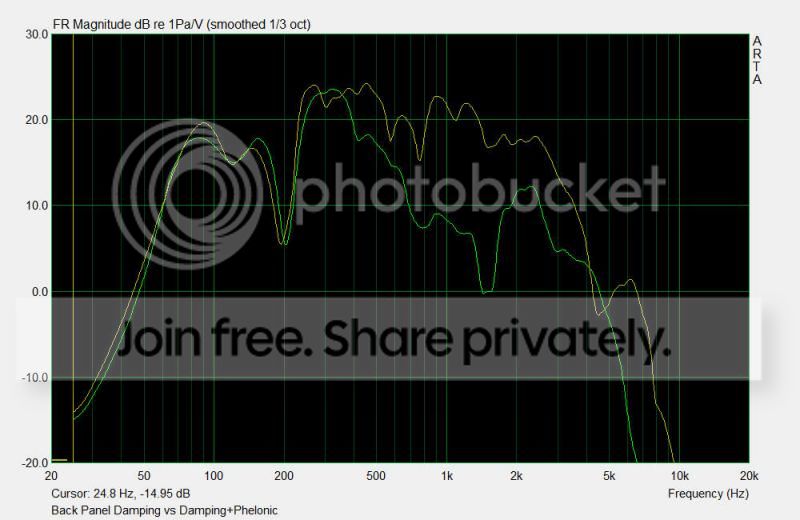
Working on the back panel today. It will be layer damped using a sheet of phenolic resin (famous brand name Tufnol). The BBC tried layer damping and concluded that it did work really well but was too expensive for the original LS3/6. They used a steel sheet to restrain the damping layer but I've used phenolic sheet because it is similarly strong as a mild steel sheet with the added benefit of already being well self-damped.

This is the difference between the back panel as standard (yellow) vs. the same thing with a phenolic sheet to constrain the damping layer (green).

The interesting thing is you can really feel the difference in the 'wobble' of the panel if you simply hold it at one edge and whack it with the soft part of a fist. The panel with phenolic constraining layer feels much more solid and doesn't wibble-wobble in your hand after hitting it.

BackPanelDamping.jpg
 
Why do you use a different construction for the back panel? Presumably, if the phenolic resin layer is beneficial there, it should be so elsewhere?
Hi Markus,

It's being tried elsewhere in the cabinet but so far seems most beneficial on the back panel. probably because it doesn't have the panel coupling links.
We were listening to the loudspeaker yesterday and most of the cabinet is now remarkably dead, but we've found some residual unwanted output from the baffle and particularly where the driver baskets and plates mount to the baffle. That's the next area for attention and phenolic might well feature there - perhaps with the mounting plates machined from it.

The mid and top are sounding very sweet and open indeed, and the sensitivity using the passive crossover is measuring at just over 90dbw.
 
Simon>
Question for yourself. just how much of an overhead is it to use real wood for the case of a loudspeaker?
Real I ask is that my present speakers do use a solid wood front baffle, just surprised that more speakers don't.
 
Hi Mike,

The reason is not cost or labour (although it does vary with materials) so much as the fact solid timber moves with climate and glued joints can crack or the timber will. The baffle with your speakers is only screwed on I presume, so it has the ability to move as it wishes. I doubt it is glued. Additionally, the BBC research shows that birch plywood is acoustically better due to the alternate direction of the wood grain in each layer. Solid timber behaves differently with sound waves passing across or along the grain. You might want to be mindful of which direction the modal patterns are passing through the material. MDF however is no better at all so choosing MDF over solid timber is not an acoustical choice.
 
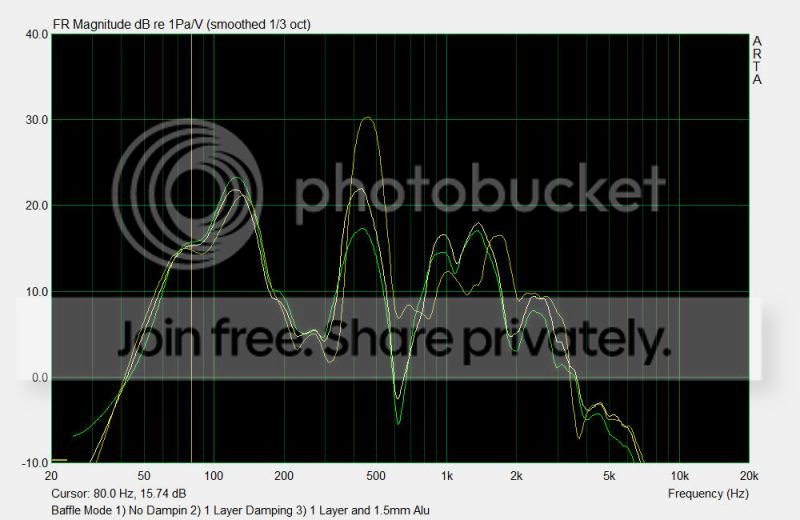
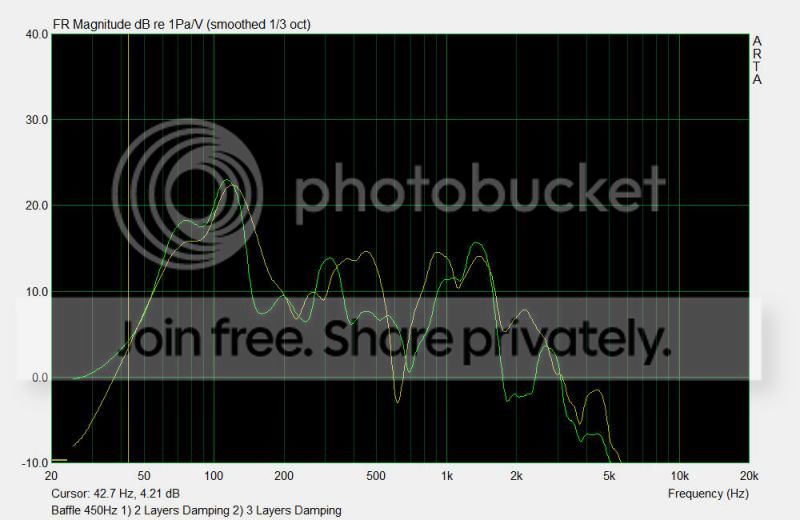
Baffle damping experiments conducted. It is interesting to find that 2 layers of damping sheet are slightly more effective than 1 layer and phenolic constraining layer. This is in contrast to the back panel where exactly the opposite was the case. I can only suppose it is due to the back panel being a nice clean rectangle while the front baffle has a more complex modal pattern due to the shape of driver cutouts. At any rate, whatever the reason this was the most effective so it is what will be used.

With regards to Markus' question about why not using the same damping methods as the rest of the cabinet. That is because the cross-links on the sides and top/bottom are very effective when the panels are exactly opposite, so the energy in each can cancel out very tightly. However the back panel and the baffle are not equal and opposite panels so they need any resonances to be tackled individually.

The faceplate material for the midrange and tweeter was also found to be critical. An attempt with cast acrylic didn't look (or sound) so good. Thick aluminium is the best so far but I'll try some thick phenolic sheet soon too as I suspect it will be even better.

Here is a 450Hz resonance on the front baffle. From top to bottom 1) No damping, 2) 1 layer damping sheet, 3) 1 layer damping sheet with phenolic constraining layer.


Baffle450HzDamping.jpg


Next we have- 1) 2 layers damping sheet, 2) 3 layers damping sheet. This was without constraining layer.

Baffle2and3LayerDamping.jpg
 
A speaker designer once told me that the front baffle is the hardest to get real quiet, but also by far the most important. The hierarchy then goes back panel, bottom panel, all the rest, he claimed.

I'm sure you will damp the internal standing wave between top and bottom panel; maybe the cross-panels can help you there?

For the faceplate, I'd also consider POM (Delrin or equivalent).
 
Last edited by a moderator:
The 'sound' of the baffle was interesting.
For the most part it appeared to contribute nothing much at all, then we noticed that certain vocal chest sounds would spark an effect, a sort of cloying richness as if the energy wasn't clearing quickly enough.

The importance of the baffle in terms of making it quiet certainly makes sense since it's the first junction for energy transmission after the driver.

I've heard similar problems in the past but always assumed it was side or rear panels.
The classic example was the old Celestion SL6, which had many good qualities but was always spoiled by a thick, clogged-up and boxy lower mid.
Back in the day I tried all sorts to control and damp the cabinet but to no effect. I didn't look at the baffle - figuring its well supported at the periphery, and the drivers were effectively stiffening the central part. I now suspect this was incorrect, and the source of the problem. Hindsight eh......
 
A speaker designer once told me that the front baffle is the hardest to get real quiet, but also by far the most important. The hierarchy then goes back panel, bottom panel, all the rest, he claimed.

I'm sure you will damp the internal standing wave between top and bottom panel; maybe the cross-panels can help you there?

For the faceplate, I'd also consider POM (Delrin or equivalent).

I'd agree that baffle may be the most important, but I think sides and top more so than back panel as the back is facing away from the listener.

Sticking a microphone inside the cabinet shows very little standing waves so that seems to be under control.

I'll have a look at POM, I've heard Derlin is nice to machine.
 
I'd agree that baffle may be the most important, but I think sides and top more so than back panel as the back is facing away from the listener.

Sticking a microphone inside the cabinet shows very little standing waves so that seems to be under control.

I'll have a look at POM, I've heard Derlin is nice to machine.

Side and top radiate away from the listener. Back panel too, but the reflection goes back straight at the listener. Bottom panel because this is where the interface to the stand is decided.
 

Latest posts

Back
Top