Why don't you care about getting good room acoustics?!

Room treatment can make a tremendous difference, perhaps the single biggest improvement you can make, I witnessed some active room correction n Munich in an admittedly poor temporary room, but the difference before and after was huge, a bigger difference than any single component could make.
Keith.
 
Room treatment can make a tremendous difference, perhaps the single biggest improvement you can make, I witnessed some active room correction n Munich in an admittedly poor temporary room, but the difference before and after was huge, a bigger difference than any single component could make.
Keith.

Hi Keith
I remember talking to u about this before, can u ellaborate on what was used?

@Richard surely there is a more constructive way to deal with this situation than move? Do u know of a 3 bed semi with bass traps on the market?
 
To address the original question:

I don't care about 'getting' room acoustics because...(in more than 50 words:rolleyes:) for one thing - I have stretched my budget to the maximum getting the gear I now have. Whether or not this is a wise use of resources when room treatment isn't included is a moot point. I also feel the various contraptions I have seen in online ads are not fit for (my) domestic environment.

Philosophically speaking, which is I guess the way the question was intended, I care about avoiding room treatments, though I value good acoustics in itself. The difference here between the 'treaters' & 'non-treaters' is the need to fix a problem; If the room is an intrusive problem then it must be dealt with as you see fit. For my part I have changed parts of the HiFi to good effect. I don't see my room as a problem, in spite of its poor acoustics - my systems ability to relay the life & energy of a piece is not compromised by these acoustics. In HiFi terms my room is crying out for improvement, but my system is performing, the music is right.

I would illustrate my thinking to you this way: I can go to a concert & enjoy it immensely even with less than ideal acoustics. I can go to a concert where the performers are not in the groove, or hungover, or don't want to be there for whatever reason - and the venue may have impeccable acoustics - but the music stinks, even if it is competently performed. The acoustics quality or otherwise is really missing the point. I feel much the same way about room treatments & EQ etc, improvements in HiFi terms are not all important to me (though it would be nice).

What I do find in treated rooms is that they feel dead to me, I can hear the blood rushing in my ears as soon as I step in. Rooms that are treated in a targeted way are somewhat better, but the above effect is still there, just targeted to the music. I haven't found this beneficial to my enjoyment of the music. As regards digital EQ I don't yet have experience, though in principle I believe adding more (highly intrusive) components to the signal path probably is a bad thing. To say its in-room benefits outweigh this compromise is again missing the point - though not in HiFi terms for sure.

I hope you can understand my thinking, even if it is different to some prevailing wisdom. I also hope I don't get my thinking 'corrected' over this, 'flat' though it is. ;)
 
With regard to treated rooms I think the end result depends entirely how the treatment is applied.
I see it as an extension of the furniture and fittings.
So for example, lots of vinyl LPs on a rack against a wall will act as a diffusor, and a well upholstered arm chair will have some bass trap effect.
Acoustic treatments simply manipulate the room acoustics in the same fundamental way but will often allow a more targeted effect.
So a listening room that is inappropriately furnished can sound bad in the same way as a poorly or over-treated room can sound bad.

You can easily overdo things though and such rooms do sound odd.
 
there is a big misconception going on here.

a big one.

A lot of visitors to my place comment that they like my room art.

It's not room art. They are absorbancy panels, that I've covered in a really nice fabric.

Bass traps that I bought from Tenson years ago occasionally get the question - what are they? - but mostly they go un-noticed as they are white, and blend in with the colours on the walls.

On the side walls, I use (as Rob rightly says) LP shelves for deflection.

Unfortunately I can only do this on one side, due to a fireplace on the other.


Under the carpet - completely invisible therefore are two layers of ''lead-like'' sound absorbancy matt. This was bought to help not disturb my neighbours. Another effect it has had (and I knew it would) is that the bass performance of the speakers improved considerably. My one regret is that I didn't put a couple more layers down while I was at it.

So, nothing is perfect. I know what i have is a big improvement over the bare room - I know this because I've heard both.

Going one step further - Id rather have budget components in a great sounding room, than high-end components in a poor sounding room.

To what extent?

Well how about my second hand mission 751's, a Cyrus II amp and a DVD player as a source.. I'd rather have THAT in a great room than my fully blown ''ridiculously sized'' (according to many) system in a reflective, unabsorbant, flimsy-assed room :D


I think what people need to deal with is a mental attitute to spending money on getting it right..

I mean £1,500 on a DAC - sounds ok ?

£1,500 on room treatments? - shock horror !!!! murder !!!!

I KNOW what will give you bigger bang for your buck...
 
Exactly my thoughts, at the Munich show we spend the majority of the setting up time on the room itself, and the difference pre and post treatment is vast.
The thought of a room made 'perfect' by the combination of active room correction and traditional acoustic treatment is very beguiling.
Keith.
 
3998000316_f17cbf9c1e_o.jpg


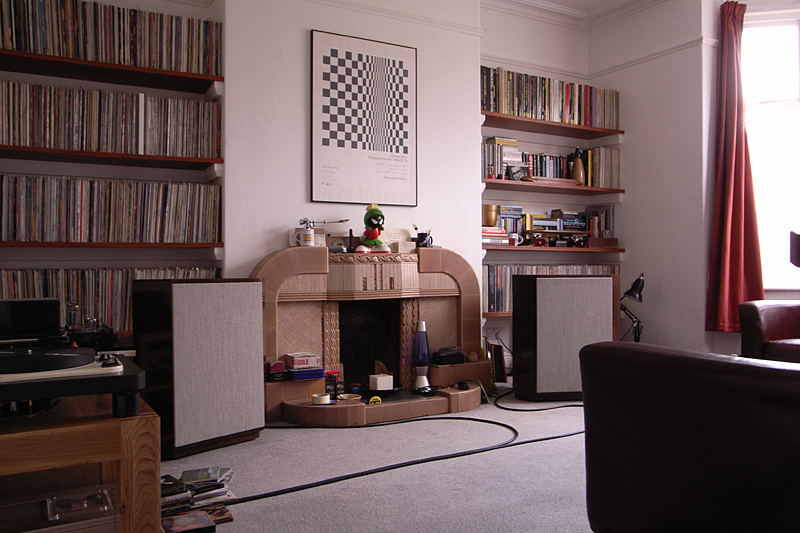
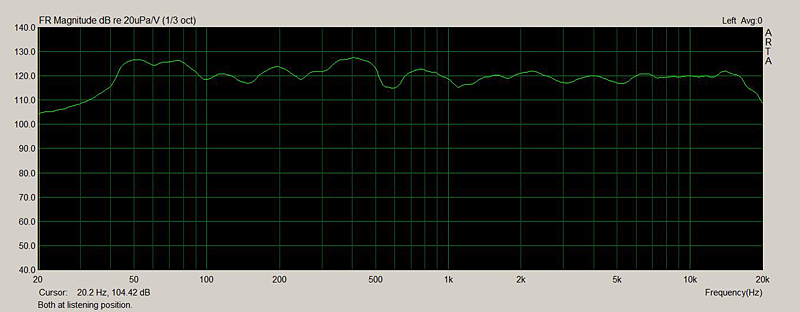
I've got records and books shelved up in the alcoves behind my speakers, carpet with thick underlay to have a 'dead end' to balance the 'live end' of the celling, plus curtains in the bay window and a very large painting above the deck to take the edge off that dimension. My speakers (Tannoy Monitor Golds) being horns from the mid up are directional so wall splash is pretty minimal anyway - I love the way horns fire stuff at the listener, not all over the place. It all measures pretty good despite the sofa being close to the rear wall. Here's a white noise plot measured at the listening position with both channels driven:

3945256119_347e1ee8a4_o.jpg


A few wobbles in the bass area, but nothing that booms or honks at all, it just gives a rather nice feeling of weight. Nice and fast too as the speakers are infinite baffle. The room feels very natural to talk in, it is neither echoey or dead, just feels about right to my mind.

Tony.
 
There comes a point when consideration to room acoustics must be tackled to justify further expenditure on equipment or you are in danger of pouring shedloads of dosh into changes in sound rather than improvements.
Unfortunately with respect to this topic, the simplest of systems will benefit from corrected acoustics but folk would rather spend money on hardware - I have!
 
I use acoustic panels in my listening room - four in fact. One large between the speakers, two at the first reflection points an a long one positioned on the wall behind the seated listeners ears. I certainly am not tempted to remove them and would certainly look to reinstall them in the next room the hi-fi ends up living in. There are quite a lot of pictures hanging in my listening room and the sound panels blend quite well - but then they were custom designed to do just that. I think aesthetic considerations are the biggest reason people don't more commonly use panels of this nature (that and the fact that there seems to be a lot of choice with some contradictory advice from manufacturers).

My room already sounded pretty good before the panels were fitted and I don't think it would be easy to transform an actively poor room into a good one just by adding passive correction (unless you were prepared to fit a heck of a lot). I'm less keen on the idea of active correction - in theory it can work but I've not been convinced by what I have heard so far.
 
Put it this way, both my 'listening rooms' (neither actually dedicated to listening) sound loads better than any demonstration rooms (which are dedicated listening rooms). My top tip is books, lots of them, and plenty of soft furnishings.
 
quote

Put it this way, both my 'listening rooms' (neither actually dedicated to listening) sound loads better than any demonstration rooms (which are dedicated listening rooms). My top tip is books, lots of them, and plenty of soft furnishings.

i agree with your motion, my room has books and records in the back wall where the sound is firing my sitting place, for an experiment i tried sound panel above the back of my spkrs and that made a tremendous difference in every way, how ever that's my room,
nando.
 
I think it's kind of ''karma'' that lots of vinyl records in shelves make for good room diffusors.

What a fantastic, wonderful and brilliant reason to go and buy records..... (like i need one but..)
 
Yeah I dont suppose I could stack a bunch of hard drives and servers and get the same effect!?......let alone afford it!
 
Whats up?!

Why doesn't anyone care about improving the acoustics of the room they listen to super expensive hi-fi in? Better room acoustics can make the most significant upgrade of any part of a hi-fi system, so why doesn't anyone care about this area of a hi-fi 'system'? In the system pictures thread I rarely see anyone with acoustic panels or even carefully placed items like book or record shelfs.

..Okay I admit acoustic treatments can look a little odd in the room, but surely given the huge investment of money most on this forum have made in electronics and speakers, they would tolerate quite a lot to get the best return from their investment? Is there some way to bash people around the head and make them pay attention to this massively important area of sound reproduction?


While I agree that room acoustics are more important than the system itself, the use of time-smearing diffuse scatterers tend to do significant harm.

Better off having solid walls & floor, a balanced amount of absorbing surfaces and well-sited electronics. All that without the putting the other half's nose out-of-joint.

Andrew
 
Interesting, can you go in to more detail about why diffusors do more harm than good?

Are you referring to the difference between incidental scattering devices and reflection phase grating diffusors, where the former show greater coherence to the original sound?
 
I would be worried about using Shroeder Diffusers when the listener is too close to them. That may well be the case in many UK sized listening rooms?

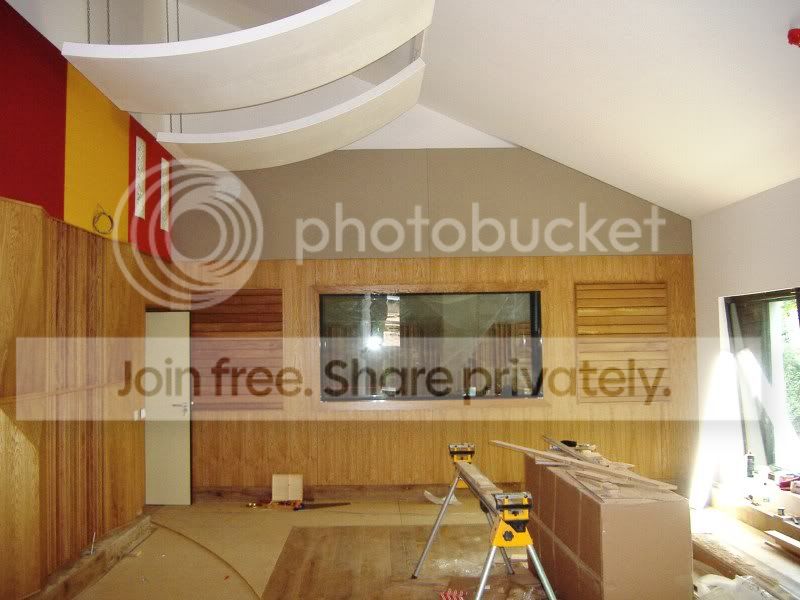
They look so nice though. Check out this "Live Room" we recently did for a residential studio outside Dublin. The ceiling slopes but is about 20ft high at the peak. Acoustic instuments sound huge in there. RT is flat at 1sec from 50Hz and up :D

DSCF0584-1.jpg


DSCF0587-1.jpg


DSCF0586.jpg
 
Last edited by a moderator:
Just a quick message for Tenson - your PM box is full and I was hoping to ask you some more qs.

Ta
 
Interesting, can you go in to more detail about why diffusors do more harm than good?

Are you referring to the difference between incidental scattering devices and reflection phase grating diffusors, where the former show greater coherence to the original sound?


didn't make much sense to me either, I'd like some evidence (other than anecdotal) for this.
 

Latest posts

Back
Top