
Why don't you care about getting good room acoustics?!

I recently installed some bass traps and foam on the wall in front of my listening position.

I have upgraded components gradually as money allowed and always found this to be a fairly easy decision, read the reviews - buy - plugin - in my experience it has always been an improvement.

Room acoustics appeared to be more of a science that put me off buying some for a long time. Everyones room is different and what you put in and where you put it is not easy to define for the inexperienced.

I bought some Auralex studio foam to give it a try, its ugly but cheaper then the home versions. Placement is shown in the pictures and based on sticking the maroon base traps in the corners and the thinner grey traps on any flat surfaces at speaker level. I have about 8 feet behind me and due to the room sit close to the speakers, about 6 feet.

Putting them in only required me to stick one of the base traps to the wall and under my desk where the subwoofer is. All the others are resting against the wall so no problem if I want to take them out.

The sound change was dramatic and a bigger jump then any component change. It sounded like the bass had been turned down and the treble became more prominent. It had more detail and much tighter bass, not bad for £150.
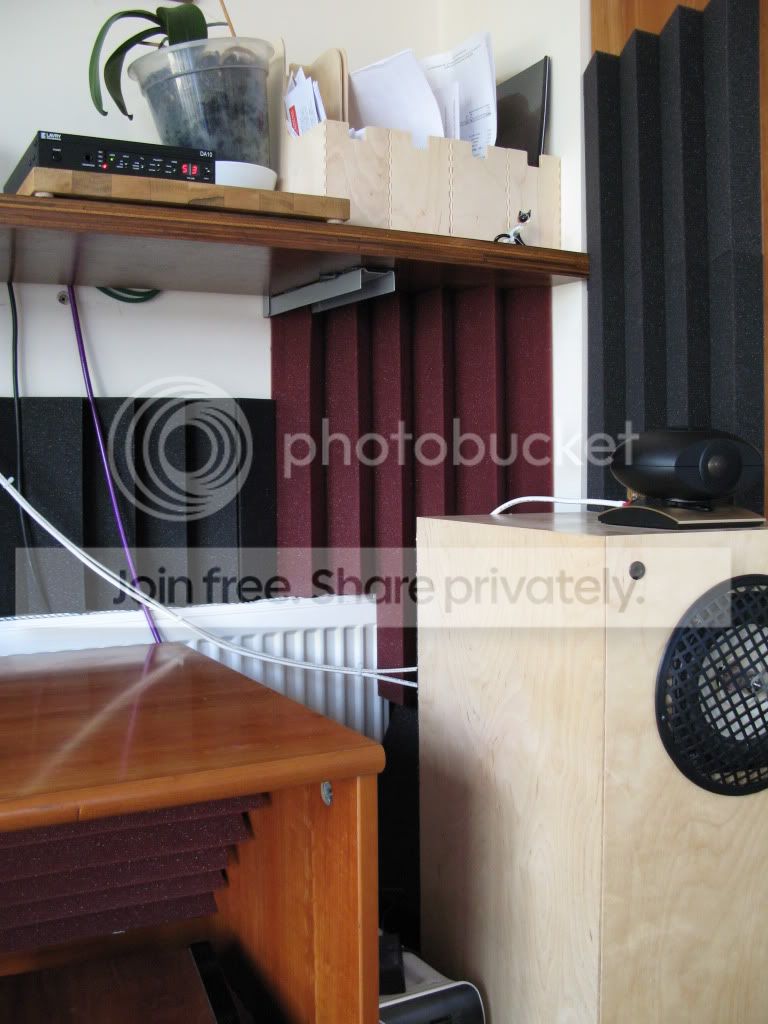
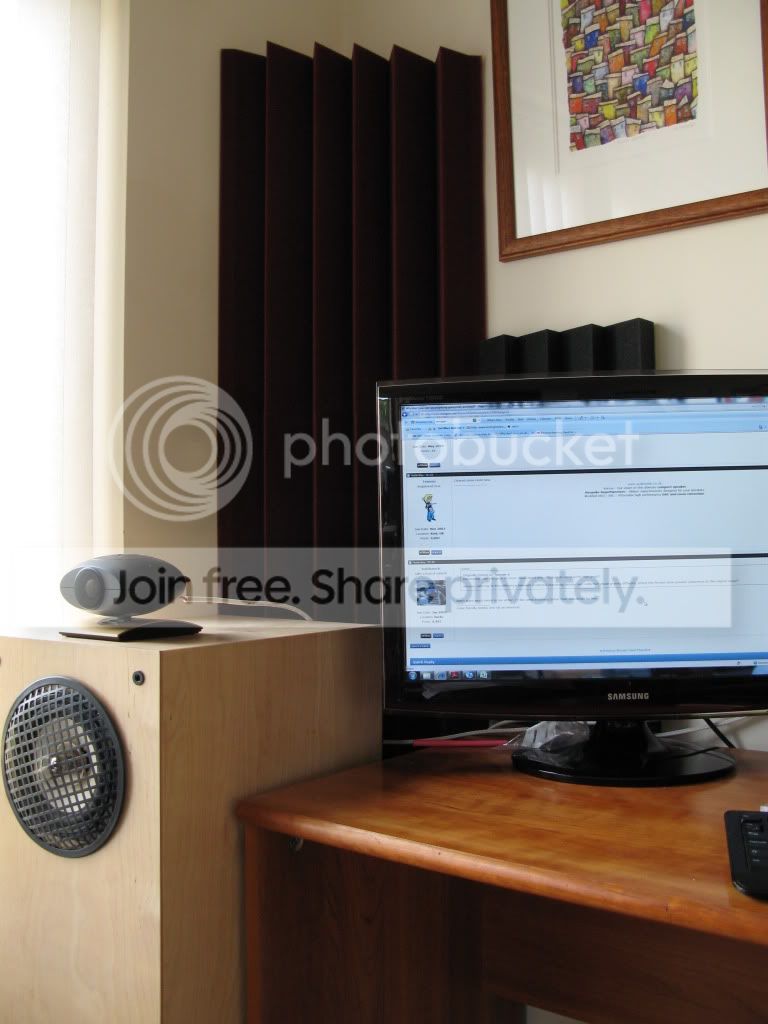
IMG_0136.jpg


IMG_0135.jpg
 
Cleared some room now.

Thanks.

I bought some Auralex studio foam to give it a try, its ugly but cheaper then the home versions. Placement is shown in the pictures and based on sticking the maroon base traps in the corners and the thinner grey traps on any flat surfaces at speaker level. I have about 8 feet behind me and due to the room sit close to the speakers, about 6 feet.[/IMG]

Hmmm... Interesting stuff. I'm thinking of trying something similar. I'm also thinking of getting some auralex platfoam to build some speaker platforms too.

Difficult to know how to go about things.
 
I did enough room treatments in the past years. The last purchase was an E-Trap last December.

I also finished playing around with tweaks (except for some resistors to put into my tube amplifiers) and I'm leaning back very relaxed on my chair.
 
It's still shocking that proper attention is rarely paid to rooms containing expensive equipment. I recently attended two auditions in which some very fancy gear was hobbled by a completely neglected listening environment. Ironically, both auditions were in the homes of manufacturers.

It's axiomatic that vibration emanating from speaker drivers and cabinets also interacts with walls, floors, ceilings and furnishings. For some really interesting explorations of this, check out the work of Toshiya Tsunoda and Alvin Lucier.

One of the most effective recent attempts to consider the speakers and room seamless parts of the same system is the Emerald Physics / Spatial system that tunes an active crossover in response to the room the speakers are placed in: common sense.

I really endorse the idea that a cheap system in a good room will sound better than an expensive one in a bad room.
 
It's still shocking that proper attention is rarely paid to rooms containing expensive equipment. I recently attended two auditions in which some very fancy gear was hobbled by a completely neglected listening environment. Ironically, both auditions were in the homes of manufacturers.
I do understand dealers who don't pay too much attention to the room acoustics since they want to persent the sound of the system in a average acoustic environment like the average people have. The best thing would be to demonstrate the same system in two environments, average and optimized, depending on if the client will want to optimize acoustically his environment.

It's axiomatic that vibration emanating from speaker drivers and cabinets also interacts with walls, floors, ceilings and furnishings. For some really interesting explorations of this, check out the work of Toshiya Tsunoda and Alvin Lucier.
I love to hear concerts in halls that decently vibrate with the orchestra (Vienna, Tonhalle Zürich, Bale, ...). Their acoustics are great even if other much more dried acoustic halls like Lucerne have their positive aspects.
My room does vibrate with powerful music even if it has a nearly to dry acoustic (mostly < 0.25 sec down to 100Hz and < 0.32 down to 50 Hz). There is nobody who complaint about it.

One of the most effective recent attempts to consider the speakers and room seamless parts of the same system is the Emerald Physics / Spatial system that tunes an active crossover in response to the room the speakers are placed in: common sense.

For me using a (active) crossover or EQ and other electronic devices is not the right way to solve acoustic problems. It just the easiest way to compensate an error which is somewhere's else. If there is a problem with the room acoustics then solve it by changing the room characteristics in the first place, not by changing / bending the music frequencies.

I really endorse the idea that a cheap system in a good room will sound better than an expensive one in a bad room.
A part from the fact that some cheap systems are anyway better than some expensive ones independent in which room they play, such a popular statement can be true or false depending on lots of factors: how much better is one system better than the other in the same room, how much different are the acoustics in the two rooms, what sound characteristics are you considering and with which priorities you are taking in consideration when you are comparing.
 
Last edited by a moderator:
Fair cop: too big a generalisation: 'cheap system in good room > expensive in bad'.

But assuming you buy new, and only the best value at the price point, the room will make your system sound 'y'% better than a system of given value 'x', allowing for diminishing returns at an inverse square rate, according to the following equation:

Happy room = y*(1/x^2)

This is always true, no matter what anyone says, even if they're right.
 

Latest posts

Back
Top