
You are using an out of date browser. It may not display this or other websites correctly.
You should upgrade or use an alternative browser.
You should upgrade or use an alternative browser.
Effects of metal enclosures on circuits
- Thread starter RobHolt
- Start date

- Joined
- Jul 5, 2006
- Messages
- 1,198
- Reaction score
- 0
This is even worse bullshit than the last one. So it is a digital amplifier, so what will you hear. Well remember dial-up and that noise it made before connecting you, well that is all it will be capable off and probably not even as musical as thatWhy dont you quote the full thing in context, not bits of it to make your own meanings...
From Tact...
Having said all of this it is worth pointing out, that the Tact's True Digital Amplifiers are not amplifiers at all. They are D/A converters that just happen to put out enough current and voltage to drive speakers directly, without the need of any amplification. This way it will perform the functions of: D/A converter, Preamplifier and Power Amplifier, without having any analog circuitry after D/A conversion other than one coil and one capacitor performing a 60 kHz, 2nd order low-pass filter.
Essentially, the hundreds of active and passive components usually required for amplification are gone!
 , because unless there is an analogue signal no speaker will reproduce music it will just be garbage. Then they start talking about watts and amps, well it can't, there has to be an amplifier. I think this is a con job, the amp is built into the output stage of the dac, so they say it is part of the dac. That is nonsense, it is an analogue amplifier - full stop! it cannot be anything else until someone invents a digital loudspeaker.
muz640 said:... Tact's True Digital Amplifiers are not amplifiers at all.
See, .... I told you so
 ..... digital amplifiers don't exist, ... they are marketing nonsense.
Dacs, btw, work at transistor to transistor level, and won't drive loudspeakers directly, so they need power amplifiers.
Power amplifiers to drive loudspeakers are analogue devices necessarily so.
The only way that Pact can make encapsulated amps in a plastic chip case is by using class D amps. It's nothing to do with 'digital'. The amps come after the output of the dac, which is by definition 'analogue'.
You need to understand a bit more about fundamental electronics and not rely so much on marketing hand-out information designed solely to sell product.
These plastic chips, by power amp standards are very small, consequently the power of them is described in apparently very advantageous terms, and they do not measure up when using the same definitions of power. This is not to say they don't have enough power to drive loudspeakers, but often not demanding ones.
Also the distortion figures at high power are significantly worse than good class A/B amps, which are not so small and do dissipate more heat, but they sound good.
JC
The only way that Pact can make encapsulated amps in a plastic chip case is by using class D amps. It's nothing to do with 'digital'. The amps come after the output of the dac, which is by definition 'analogue'.
You need to understand a bit more about fundamental electronics and not rely so much on marketing hand-out information designed solely to sell product.
These plastic chips, by power amp standards are very small, consequently the power of them is described in apparently very advantageous terms, and they do not measure up when using the same definitions of power. This is not to say they don't have enough power to drive loudspeakers, but often not demanding ones.
Also the distortion figures at high power are significantly worse than good class A/B amps, which are not so small and do dissipate more heat, but they sound good.
JC
My first post asked by asking if anyone had heard this type of amp before dismissing class D type amps as "nonsense"
You explained to me in your experience they aren't any good. But please put it in context of type of amp you have heard.
"The only way that Pact can make encapsulated amps in a plastic chip case is by using class D amps. It's nothing to do with 'digital'. The amps come after the output of the dac, which is by definition 'analogue'.
"
Please clarify what plastic chip case means because i dont understand this bit, and...
" Originally Posted by jcbrum
I have heard them. The ones I heard were in 'active' speakers, and in subs, and in physically small amplifiers in plastic (perhaps acrylic) cases with unusual shapes.
Generally they aren't as powerful as the specs would suggest, with relatively high levels of distortion.
They seem to me to be more suited generally to RF amplification than AF.
JC"
Please clarify what the above is ? 'perhaps acrylic' and 'unusual shape' doesn't tell me what type of amps in your 'experience' you have listened too.
Might be refering to the the Tripath and ICE modules, which come as what are regarded as chip amps in a plastic package.
Yes but he need to be clear on what he actually talking about, if you going to be patronising, best be clear on the details.
I gave the Tact amp as example, which obvouisly people dont like the marketing blurb that goes with it, thats fine, but if you dont like it, take it up with them or trading standards!
This is the Tact amp

My original question was asking if anyone had heard the class D amp before dismissing them as "nonsense"
TBH i wish id never bothered :MILD:
Last edited by a moderator:

- Joined
- Sep 28, 2009
- Messages
- 35
- Reaction score
- 0
One of my favourite pieces of meaningless graphics demonstrating the clear advantage of B & O's ICE power modules.
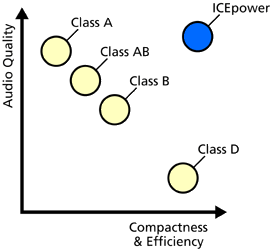
LOL. Who needs to listen?
LOL. Who needs to listen?
Muz, yes I'm not a fan, i've yet to hear one sound unprocessed.
Yes i can absolutely understand where you are coming from, even with roomperfect disengage they have a certain calmness and control about them that isnt quite right, this become more aparent after youve lived with one for a while, they have some real strengths though, and im wondering how they can be improved.
Interestingly I know John Westlake has built this 'Power Dac" style of amp, and says its the best amp he's heard, its somewhere in the DAC thread over on DIY forum.
I think HiFace are making one as well, interesting times ahead.

LOL. Who needs to listen?
Because if you dismiss something without hearing it yourself you have a closed mind.

bottleneck
talks a load of rubbish
One of my favourite pieces of meaningless graphics demonstrating the clear advantage of B & O's ICE power modules.
LOL. Who needs to listen?
please sir, can I move the blue smartie?
- Joined
- Sep 28, 2009
- Messages
- 35
- Reaction score
- 0
Because if you dismiss something without hearing it yourself you have a closed mind.
I'd absolutely agree & have taken the trouble to listen to Bel Canto's (several times) Nu Forces, TriPath and various other switching amps. I think they are an interesting technology but I'm not convinced their natural application is in high quality audio.
bottleneck
talks a load of rubbish
yes, I have listened to all of the aboev also. There is a difference between them too.
Initial impressions suggest I prefer the Nu-force to the others above.. however none of them really fill my personal boots.
It's a matter of personal preference as so much else in hifi..
Initial impressions suggest I prefer the Nu-force to the others above.. however none of them really fill my personal boots.
It's a matter of personal preference as so much else in hifi..
I'd absolutely agree & have taken the trouble to listen to Bel Canto's (several times) Nu Forces, TriPath and various other switching amps. I think they are an interesting technology but I'm not convinced their natural application is in high quality audio.
Yes i agree im not massively keen on the Bel Canto amps or the other switching amps ive tried, IMO the TDA Lyngdorf /Tact amps (Millennium TDA2200 etc) were better sounding.
From the first post i made i never said they were perfect or better than other classes of amps, i said they were 'interesting' and have some real strengths despite their faults and asked whod heard them.
Its a pain in the arse to keep defending yourself because you ask a question TBH, obviously this has been twisted by one patronising poster who makes every forum he partakes in a much worse place to be.
Last edited by a moderator:
- Joined
- Sep 28, 2009
- Messages
- 35
- Reaction score
- 0
If someone needs a cool running multi channel amp for an AV application then this technology is perhaps the most effective way of giving adequate quality & power without excessive cost.
I've only heard the Tact stuff at shows & couldn't really offer an opinion on it.
Martin Colloms has been rather savage in his criticism of this kind of amplifier.
http://www.mediafire.com/?sm0kpotkkcexb2l
Certainly any conventional amps that gave a measured performance such as some switching ones give would not be taken seriously & with good reason.
I've only heard the Tact stuff at shows & couldn't really offer an opinion on it.
Martin Colloms has been rather savage in his criticism of this kind of amplifier.
http://www.mediafire.com/?sm0kpotkkcexb2l
Certainly any conventional amps that gave a measured performance such as some switching ones give would not be taken seriously & with good reason.
Martin Colloms has been rather savage in his criticism of this kind of amplifier.
http://www.mediafire.com/?sm0kpotkkcexb2l
Certainly any conventional amps that gave a measured performance such as some switching ones give would not be taken seriously & with good reason.
But you could say the same about the measured performance of a Tube amp, doesn't mean it wont sound good when you listen to it yes ?
A link to a test of the cheaper amp compared to a 300B amp from Noel Keywood
Im not making the case for or against them, just saying they are interesting and asking what people think, a poster stating things are "nonsense" and then not being specific isn't helpful.
Last edited by a moderator:

RobHolt
Moderator
- Joined
- Oct 23, 2004
- Messages
- 4,126
- Reaction score
- 12
If someone needs a cool running multi channel amp for an AV application then this technology is perhaps the most effective way of giving adequate quality & power without excessive cost.
I've only heard the Tact stuff at shows & couldn't really offer an opinion on it.
Martin Colloms has been rather savage in his criticism of this kind of amplifier.
http://www.mediafire.com/?sm0kpotkkcexb2l
Certainly any conventional amps that gave a measured performance such as some switching ones give would not be taken seriously & with good reason.
Careful, we'll end up with another 'do specs and measurements matter thread'

- Joined
- Jul 5, 2006
- Messages
- 1,198
- Reaction score
- 0
Nope! they don'tCareful, we'll end up with another 'do specs and measurements matter thread'

Nope! they don't
C S Lewis had the rights of it. "A belife in invisible cats cannot logically be disproved. But it does tell us a good deal about those that hold it"
Chris
Last edited by a moderator:
- Joined
- Jul 5, 2006
- Messages
- 1,198
- Reaction score
- 0
But I can't hear invisible cats, but I can hear, quite clearly, that written specifications are largely a load of old bollocks that do not correlate with reality. Where as I think you can safely say that invisible cats are largely also a load of old bollocks (unless they have been neuteredC S Lewis had the rights of it. "A belife in invisible cats cannot logically be disproved. But it does tell us a good deal about those that hold it"
Chris
 )
)Belief has nothing to do with it, my audible reality has.