
You are using an out of date browser. It may not display this or other websites correctly.
You should upgrade or use an alternative browser.
You should upgrade or use an alternative browser.
Flat earther?
- Thread starter h.g.
- Start date


RobHolt
Moderator
- Joined
- Oct 23, 2004
- Messages
- 4,126
- Reaction score
- 12
m.f. are bringing out a tone box better looking than the old x-tone with more slope facilyties.
Excellent news Joseph.
Any idea on cost yet?
I agree. That's why ES14s are so superb in all ways.
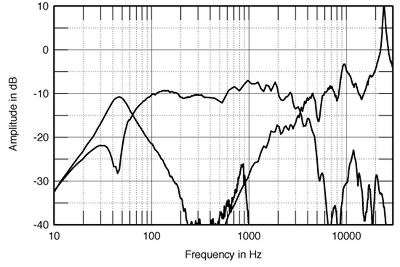
Stereophile review ES14 frequency response for each driver plus port.
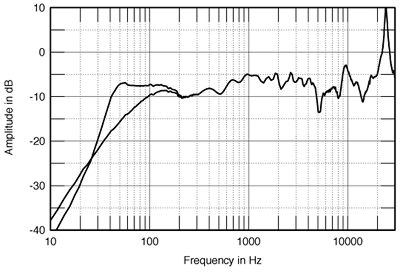
Stereophile combined ES14 frequency response curve. Upper curve is open port, lower curve is closed.
The ES14's have a good or even very good frequency response curve.
However I wouldn't call it a superb frequency response curve. You have a choice between bass rolling off at 100hz or listening to port noise below 100hz or somewhere inbetween if you use port bungs. You're looking at 20db down at 30hz no matter what you do port wise.
The lower midrange between 200hz and 500hz dips to 5db's below the level at 1000hz.
From 3khz to 15khz the tweeter's giving us a series of 7db peaks and troughs.
The efficiency of 86db is likely to restrict us to ss and higher powered valve amplification - 35watt minimum recommended. Such low efficiency is not likely to be superb from a dynamic ease point of view either.
The impedance stays above 7 ohms which is superb compared to the vast majority of speakers.
I think it's interesting to compare the ES14 closed port curve against the LS3/5a.
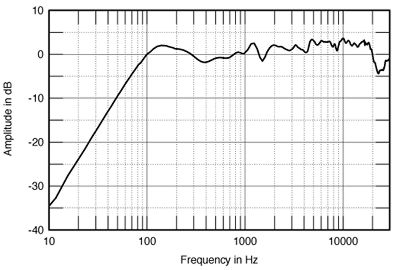
Stereophile Rogers LS3/5a frequency response curve.

- Joined
- Jul 5, 2006
- Messages
- 1,198
- Reaction score
- 0
Which just proves that frequency response curves mean sweet FA in a real world.
On axis - anechoic - what has this to do with reality.
On axis - anechoic - what has this to do with reality.
flatpopely
Trade - AudioFlat
Indeed the ES14s sound very even and open across the whole frequency range.
flatpopely
Trade - AudioFlat
I actually sell Tannoys and although I do rate them highly I never really 'get' the dual concentric thing!
RobHolt
Moderator
- Joined
- Oct 23, 2004
- Messages
- 4,126
- Reaction score
- 12
Which just proves that frequency response curves mean sweet FA in a real world.
On axis - anechoic - what has this to do with reality.
Not sweet FA, but they need viewing with caution.
Anechoic responses do give you a flavour and will also indicate any serious problems.
They need to be viewed in combination with room averaged plots which evens out the smaller peaks and dips. These are far less audible than broader trends.
Most listeners tend to listen close to on axis, if not directly on.
That's why a range of plots are useful.
If a speaker has a ruler flat response on axis, but a huge crossover suck-out when you move say 45 deg off axis - you will hear this effect on axis because you also hear the reflected sound in the room, and this of course includes the suck-out. It is one reason why good crossover design is so important and a good crossover has good responses both on and off axis.
So we need more/better measurements, not less!
Just a point on the ES14.
It is meant to have aperiodic loading which when implemented carefully gives most of the benefits of a sealed box but lowers the main system resonance, allowing the system to go lower in the bass.
The ES14 should use a porous bung in the port. Fully open and fully closed is wrong.
Open cell speaker cover foam is good for the job. Roll it lightly into shape and pop into the port.
Indeed the ES14s sound very even and open across the whole frequency range.
They do and that is a tribute to the skill of Robin Marshall.
Tweeter is the week area IMO, though it is still good. Small domes don't like going too low on such a shallow crossover slope. Robin stated that his aim was to use a good ribbon on the ES14 at some point.
Well a true ribbon might not work ideally but a nice isoplanar might

Joe Petrik
Denebian Slime Devil
- Joined
- Jul 16, 2007
- Messages
- 121
- Reaction score
- 0
Rob,
None of the FEP surveys was meant to be taken seriously, though some really did believe they were a carefully designed metric and that a low score was a sign of deficient character or something. All they actually measure is my understanding, or lack thereof, of what constitutes good hi-fi at the time of writing.
If I draft a 3.0 version I'll include a section on good vintage kit, especially good idler decks, as they are obviously excellent and the best of them out-funk the standard fare of FE decks. (This is another reason why the FEP survey shouldn't be taken seriously. I wasn't even aware that idlers were hi-fi until a few years ago.)
Joe
Maybe I should work on FEP 3.0, as the one kuma put on the Briks site was written almost ten years ago.Worryingly, I now score 175 FEPs which is higher than when I had a Linn/Naim system!
Joe, I think perhaps you should add a question about tone controls. Having them would -100 points
None of the FEP surveys was meant to be taken seriously, though some really did believe they were a carefully designed metric and that a low score was a sign of deficient character or something. All they actually measure is my understanding, or lack thereof, of what constitutes good hi-fi at the time of writing.
If I draft a 3.0 version I'll include a section on good vintage kit, especially good idler decks, as they are obviously excellent and the best of them out-funk the standard fare of FE decks. (This is another reason why the FEP survey shouldn't be taken seriously. I wasn't even aware that idlers were hi-fi until a few years ago.)
Joe
quote
I actually sell Tannoys and although I do rate them highly I never really 'get' the dual concentric thing![/QUOT
it works, trust me,
RobHolt
Moderator
- Joined
- Oct 23, 2004
- Messages
- 4,126
- Reaction score
- 12
Joe, I got confused when answering the speaker related questions, given that I have 12 pairs here at the moment!
Even more confusing is that the two I use often, the ESL57 and the Rogers Export sit at completely opposite ends of the FEP scale yet sound very alike
Even more confusing is that the two I use often, the ESL57 and the Rogers Export sit at completely opposite ends of the FEP scale yet sound very alike
Joe Petrik
Denebian Slime Devil
- Joined
- Jul 16, 2007
- Messages
- 121
- Reaction score
- 0
nando,
Your ears are more like a single driver in reverse, especially at the frequency extremes.
Joe
Your ears are more like a single driver in reverse, especially at the frequency extremes.
Joe
Joe Petrik
Denebian Slime Devil
- Joined
- Jul 16, 2007
- Messages
- 121
- Reaction score
- 0
Rob,
I hope among the 12 pairs you have some Autographs.
Joe
I hope among the 12 pairs you have some Autographs.
Joe
quote
yeah right, we all hear the same crap only we add a bit of know how and cosmic echoes, so we reverse polar circuits in amps, neg to poss to the speakers, and to make it better add negative feedback outputs on the amp, OLE!
nando,
Your ears are more like a single driver in reverse, especially at the frequency extremes.
Joe
yeah right, we all hear the same crap only we add a bit of know how and cosmic echoes, so we reverse polar circuits in amps, neg to poss to the speakers, and to make it better add negative feedback outputs on the amp, OLE!
Which just proves that frequency response curves mean sweet FA in a real world.
On axis - anechoic - what has this to do with reality.
Hardly FA. The LS3/5a frequency response indicates a big drop-off below 100hz which is reflected by them sounding very lean - with an uninvolving bass with no impact.
Likewise the ES14's. Close the ports up and they're about as lean as the LS3/5as. Open the ports up and you're listening to the port more than the cone - which is reflected in the quality of the bass. Use bungs and you've got some sort of halfway house.
Sometimes objective measurements do tell you a certain amount about how a speaker will sound.
Or is someone seriously trying to say that these speakers have superb - world class bass performance? In which case I'll challenge them to a bake-off.
RobHolt
Moderator
- Joined
- Oct 23, 2004
- Messages
- 4,126
- Reaction score
- 12
Rob,
I hope among the 12 pairs you have some Autographs.
Joe
Sadly not Joe.
Bigger house needed first.